Jurassic Dinos editorial · Updated · Source-based review
What was Harenadraco?
Harenadraco was a small troodontid dinosaur from Late Cretaceous Mongolia. The species Harenadraco prima was described in 2024 from Hermiin Tsav, in the Baruungoyot Formation.
Troodontids were already known from other famous fossil-bearing formations of the Mongolian Gobi. The discovery supplied a described member of the group from a unit where that record had been missing, helping researchers compare neighbouring fossil communities more effectively.
What material was actually preserved?
The incomplete skeleton consists mainly of partially articulated left hindlimb elements, along with other fragments. It is not a complete animal preserving the skull, wings and all the feathers shown in a life portrait.
The lower limb was particularly informative. The study emphasized the extraordinary slenderness of the tarsometatarsus, the region involving the ankle and metatarsal structures. Metatarsals are the long bones between the ankle and the toes.
Was it a fast runner?
The authors interpreted its proportions as evidence of strong running adaptations, sometimes called cursorial adaptations. That interpretation concerns how limb design may have related to movement. It is not an exact measurement of maximum speed.
Running performance also depends on muscles, tendons, body mass and behaviour, many of which are incompletely known. An animated-looking pose or a long shin in an illustration cannot fill those gaps. This page therefore avoids a numerical race comparison with living animals or other dinosaurs.
Why does a missing formation record matter?
The absence of described fossils may reflect genuine ecological differences, but it can also arise from limited collecting, preservation or identification. Finding Harenadraco changes the evidence available for investigating those alternatives.
It confirms that troodontids were represented in the Baruungoyot Formation record. It does not prove that every troodontid species lived in every Gobi environment or that all the formations represent one simultaneous community. Geological time and local conditions still need to be compared.
Reading the portrait
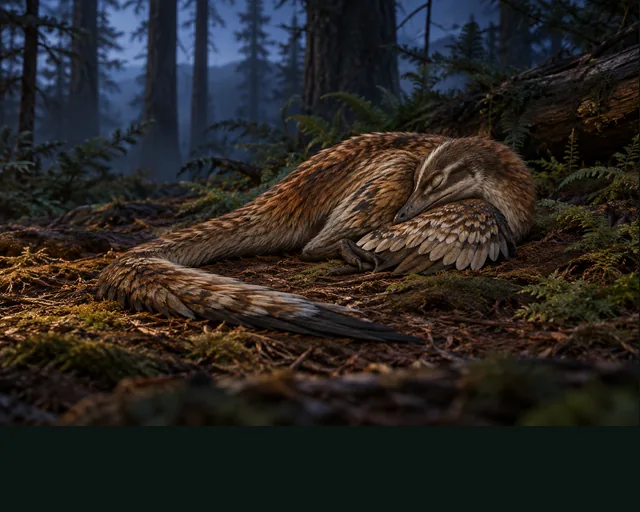
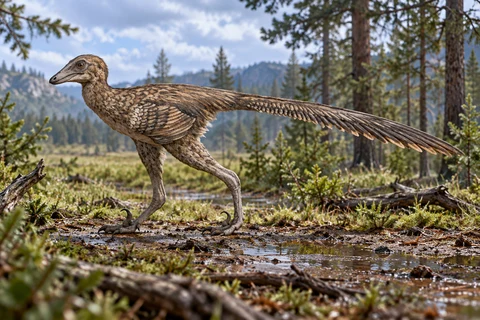
Our image follows an approved complete Harenadraco reference, retaining the small low head, slender neck, folded feathered forelimbs, long hindlegs and feathered tail. The full feather arrangement and most body contours are artistic interpretation because the type evidence is mainly from the hindlimb.
Colour, spotted pattern and setting are also artistic. The portrait does not prove powered flight, a particular prey animal or a preserved plumage pattern. Its purpose is to introduce the animal while the source record identifies the narrower anatomical evidence.
Compare Mei and Daliansaurus, then explore the H directory.
Quick answers
- Where was Harenadraco found?
- At Hermiin Tsav in Mongolia, in the Baruungoyot Formation.
- What was especially slender?
- Its tarsometatarsus, the lower limb region involving ankle and metatarsal structures.
- Do we know its maximum speed?
- No. A running adaptation is not an exact speed measurement.
- Are its feathers preserved in the type?
- The reviewed type is mainly hindlimb material; the complete plumage in the portrait is interpreted.