Jurassic Dinos editorial · Updated · Source-based review
What was Halszkaraptor?
Halszkaraptor was a small Late Cretaceous dinosaur from Mongolia with a long neck, a low snout and an unusual combination of features. It belonged to the broad raptor lineage, but its proportions differ strikingly from familiar Velociraptor reconstructions. A partly aquatic lifestyle has been proposed and debated.
What makes the fossil distinctive?
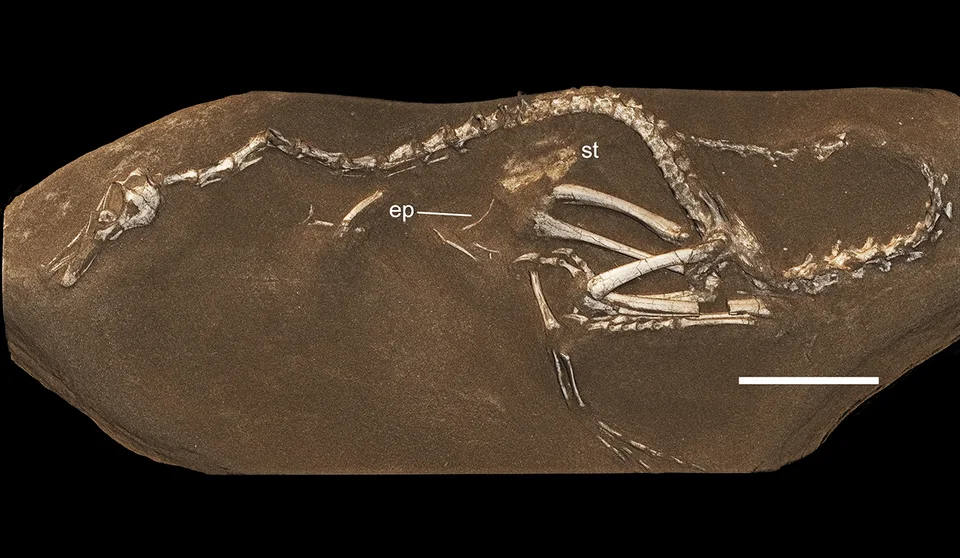
The relatively complete specimen preserves an elongated neck and short forelimbs. Detailed scanning revealed features hidden inside the rock and helped test whether the skeleton was an artificial combination of different animals. This is a reminder that scientific imaging can answer questions that surface photographs cannot. It also helps distinguish genuine bones from restored portions of a specimen.
Where was it found and how was it named?
The fossil passed through the commercial fossil trade before researchers examined it and it was returned to Mongolia. Its removal complicated the record of its precise discovery circumstances. The name honours palaeontologist Halszka Osmólska. The genus was described in 2017, drawing attention both to its anatomy and to the importance of preserving fossils with reliable locality information.
What can we infer, and what remains uncertain?
Some features have been compared with aquatic birds and crocodilians, leading to a semiaquatic interpretation. Other researchers have questioned that ecological conclusion. The responsible description therefore explains the proposal instead of calling the animal a proven swimming specialist. Similarity in one body part can reflect several functions. Compare its neck and snout with those of another dromaeosaur, and ask which observations support the proposed behaviour and which are extrapolations.
Was Halszkaraptor simply a prehistoric duck?
No. It was a non-avian theropod with some superficially waterfowl-like proportions. That comparison does not establish the same diet, behaviour or evolutionary identity as a living duck.
How can you check the evidence?
The Paleobiology Database record catalogues Halszkaraptor under Halszkaraptorinae. Its linked bibliography identifies this research starting point: A. Cau, V. Beyrand, and D. F. A. E. Voeten, V. Fernandez, P. Tafforeau, K. Stein, R. Barsbold, K. Tsogtbaatar, P. J. Currie, P. Godefroit. 2017. Synchrotron scanning reveals amphibious ecomorphology in a new clade of bird-like dinosaurs. Nature. Open the bibliographic record. A catalogue entry establishes the source trail; it does not independently verify every later illustration or behavioural claim.
Use the dated genus overview to follow the references behind the discovery and anatomy discussed above. When sources disagree, compare which specimen and rock layer each author studied. A reconstructed whole animal can combine original bones with comparisons to relatives; those two kinds of evidence should not be confused. The account above explains the particular limits that matter for Halszkaraptor, rather than supplying unsupported size, speed or lifespan figures.
Read the image and keep exploring
The articulated Halszkaraptor specimen shows its long neck and compact body in the same slab. A displayed specimen or skeletal mount can include restored parts. Its appearance should be read alongside the original specimen description.
Compare Velociraptor, Buitreraptor, Microraptor. Find more names in the H index and explore theropod field notes. The glossary explains unfamiliar fossil terms.
Quick answers
- Where have Halszkaraptor fossils been found?
- The discoveries discussed here come from Mongolia. Modern place names describe discovery locations, not a complete ancient geographic range.
- When did Halszkaraptor live?
- It is placed in the Cretaceous period. See the discovery discussion for qualifications about the particular rock layers and dating.
- Where can I compare Halszkaraptor with related dinosaurs?
- Follow the related field notes below. Comparisons explain shared anatomy; they do not imply that all the animals lived together.