Jurassic Dinos editorial · Updated · Source-based review
What was Guaibasaurus?
Guaibasaurus was an early dinosaur from the Late Triassic of southern Brazil. Its species, Guaibasaurus candelariensis, is known from the Caturrita Formation record of Rio Grande do Sul.
It belongs to the investigation of early saurischian evolution, when the branches leading toward later theropods and sauropodomorphs were already diversifying. Its precise position has been debated, so a confident label such as miniature long-necked dinosaur or ordinary meat-eating theropod would conceal an important part of the story.
Why is its family position difficult?
A 2011 reassessment examined the originally referred specimens and additional material. The authors found a combination of ancestral features and traits resembling more derived saurischians. Their analyses offered only weak support for a position within Theropoda.
An ancestral feature is one retained from earlier relatives; a derived feature is a later modification in a particular lineage. Early dinosaurs can combine them in ways that complicate a simple family tree. The challenge is to test many characters together rather than classify the animal from its overall silhouette.
What does a possible resting pose reveal?
A separate study considered a specimen with folded hindlimbs beneath the body, flexed forelimbs and a curved neck. The authors interpreted this arrangement as an avian-like resting posture, supported by their assessment of the fossil’s preservation.
Avian-like means comparable in some respects to birds. It does not mean that Guaibasaurus was a modern bird, that it could fly or that this specimen preserves feathers. Nor can a resting interpretation establish whether the animal was asleep at the instant it died.
Why investigate behaviour so cautiously?
A skeleton records a final arrangement after death and burial. Researchers must consider whether transport, decay or deformation could have moved its parts. A convincing interpretation therefore needs more than noticing that the bones resemble a familiar living animal’s pose.
The value of the study lies in testing those alternatives. It may help investigate how far back some posture patterns extend, while leaving questions about daily behaviour open.
Reading the portrait
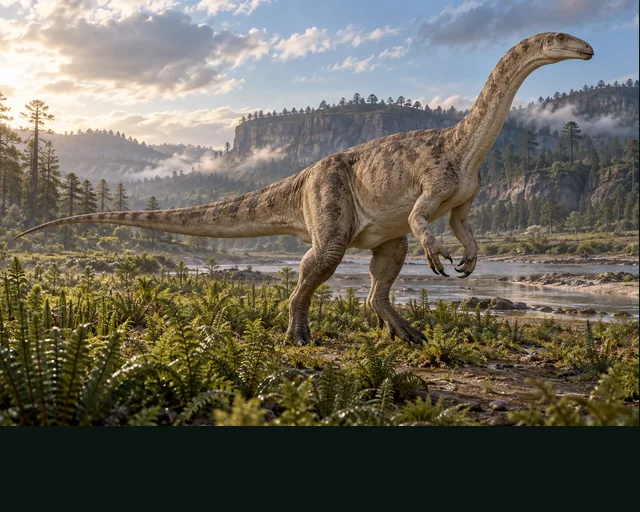
Our complete approved reference guided the small head, elongated neck, grasping hands, bipedal outline and long tail. The image shows an alert moment rather than recreating the proposed resting specimen. Its smooth head and neck outline avoid adding unsupported ornaments.
Colour, skin and soft-tissue proportions remain artistic. This account also leaves the diet unspecified rather than choosing a menu solely from a disputed family placement.
Compare Eoraptor and Plateosaurus, then browse the G directory.
Quick answers
- Where did Guaibasaurus live?
- In Late Triassic southern Brazil.
- Is it definitely an early sauropodomorph?
- Its precise saurischian position has been debated, so this account keeps a broad placement.
- What is interesting about one preserved pose?
- Researchers interpreted folded limbs and a curved neck as an avian-like resting position.
- Does that prove feathers?
- No. A posture comparison does not establish skin covering.