Jurassic Dinos editorial · Updated · Source-based review
What was Gremlin?
Gremlin was a small plant-eating ceratopsian from Late Cretaceous Alberta. The species Gremlin slobodorum was named in 2023 by Michael Ryan and colleagues. Its fossils belong to the Campanian record of the Oldman Formation.
The playful genus name should not hide the seriousness of the comparison. Gremlin is a scientific name anchored to a fossil specimen, not a fantasy creature invented for a dinosaur game.
What part of the animal was found?
The holotype is a frontal, a bone forming part of the skull roof. Carleton University’s account identifies it as specimen TMP 2011.053.0027 and explains how its study prompted a re-evaluation of characters in the paired frontal bones of related dinosaurs.
An isolated skull element cannot supply an entire living head, complete body proportions or a measured adult mass. It can nevertheless contain features useful for comparison. The question is whether those features support a distinction when examined alongside the available material of other taxa.
What kind of ceratopsian was it?
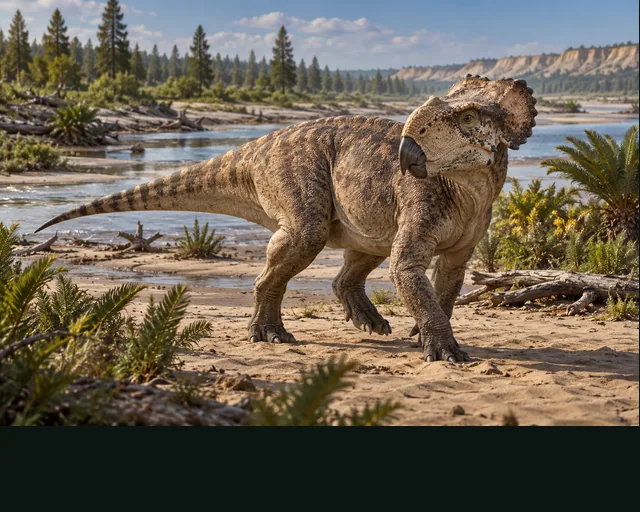
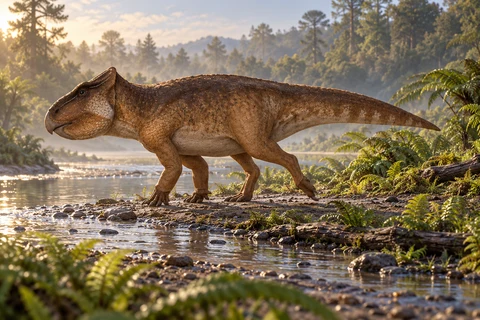
The researchers described Gremlin as a leptoceratopsid. These animals belong to the broader ceratopsian radiation but differ from large ceratopsids with spectacular facial horns. A small frill and beaked head are more appropriate to the approved life reference than a miniature set of Triceratops horns.
Descriptions of the probable whole animal should still be read as reconstruction. The preserved frontal provides a much narrower set of observations than the portrait’s complete outline. The article therefore avoids converting an estimated illustration size into a directly measured adult skeleton.
Why is its place in Alberta’s record useful?
The research institution explained that the discovery helps narrow a temporal gap between other leptoceratopsids in the region. That is a question about the sequence of fossil occurrences, rather than proof that all of those animals lived together.
An evolutionary history needs both anatomical relationships and geological ordering. Two animals found in the same modern province can be separated by considerable time, so location alone does not establish an encounter or a shared herd.
Reading the portrait
Our complete approved Gremlin reference guided the deep beaked head, low rear frill, robust four-legged body and tapering tail. The small projections along the back, mottled skin, colour and much of the body contour remain artistic interpretation.
The portrait introduces a poorly known dinosaur while the source record makes clear how limited the direct fossil evidence is.
Compare Leptoceratops and Ferrisaurus, or continue through the G directory.
Quick answers
- Was Gremlin a mythical animal?
- No. The whimsical name belongs to a fossil ceratopsian species.
- Where was it found?
- In the Oldman Formation of southern Alberta, Canada.
- What is a frontal?
- A bone forming part of the roof of the skull.
- Is the full body directly known?
- The type evidence is highly incomplete, so a complete portrait contains substantial interpretation.