Jurassic Dinos editorial · Updated · Source-based review
What was Ferrisaurus?
Ferrisaurus was a small plant-eating dinosaur from northern British Columbia. Victoria Arbour and David Evans named the species Ferrisaurus sustutensis in 2019 after re-examining a partial skeleton from the Sustut Basin. The fossils belong to the Maastrichtian interval near the end of the Cretaceous.
The animal was identified as a leptoceratopsid, a member of the wider ceratopsian group. That places it in the same broad evolutionary story as horned dinosaurs, but does not mean that its missing skull carried a Triceratops-like set of horns.
How can a dinosaur be named without its skull?
A distinctive combination of characters can occur in other body regions. The Ferrisaurus study emphasized the proportions of the ulna, a forearm bone, and the phalanges, the individual bones making up the toes.
Its material had previously been described with a less precise identification. Re-examination supplied a narrower placement and a new name. This illustrates why an old fossil drawer can produce important results: a specimen’s scientific value depends partly on the questions and comparisons available to the people studying it.
What might its limbs reveal about movement?
The original authors compared its arm proportions with those of other leptoceratopsids. They considered whether it could sometimes move on its hind legs, while also discussing other possible explanations for a robust forearm, including activities such as digging.
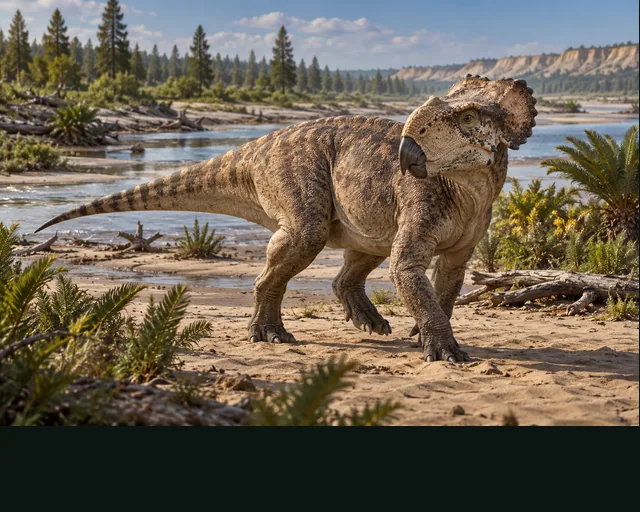
These are competing interpretations of anatomy, not direct observations of the living dinosaur. A bone’s shape may be consistent with more than one activity. An illustration of Ferrisaurus standing on four feet captures one plausible moment rather than settling how it moved throughout its life.
Why is the location interesting?
British Columbia is less famous for dinosaur skeletons than some neighbouring Canadian regions. A well-documented specimen adds a useful point to the map of Late Cretaceous diversity. It helps researchers investigate the distribution of small plant-eating dinosaurs beyond the best-known fossil areas.
That does not establish that Ferrisaurus lived throughout the whole province or shared every habitat with every related genus. Distribution maps should begin with the places where specimens were actually recovered.
Reading our reconstruction
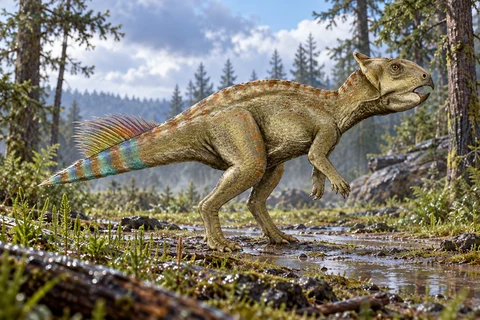
The portrait follows a complete reference specifically identified as Ferrisaurus. Its beaked head, modest rear skull contour, short forelimbs and long deep tail are parts of that artistic restoration. Because no skull is preserved in the described material, the head contour and colours must remain labelled as interpretation.
Compare Leptoceratops and Cerasinops, or browse the F directory.
Quick answers
- Where was Ferrisaurus found?
- In the Sustut Basin of northern British Columbia, Canada.
- Was a horned skull discovered?
- No. The diagnostic material consists of parts of the body and limbs.
- How was it distinguished?
- The original study emphasized proportions of the ulna and toe bones.
- Did it always walk on four legs?
- Its locomotion is uncertain; the study considered more than one interpretation of the limbs.