Jurassic Dinos editorial · Updated · Source-based review
What was Cerasinops?
Cerasinops was a small ceratopsian dinosaur from Late Cretaceous Montana. Its species is Cerasinops hodgskissi. Ceratopsians include the familiar horned giants, but the group also contains smaller animals with beaks and much less dramatic head ornament. Cerasinops should not be pictured as simply a shrunken Triceratops.
Its fossils matter because they help researchers compare early-branching ceratopsians from North America and Asia. Similarities between animals on different continents can reveal an evolutionary connection, but do not prove that one named species travelled directly from one place to another.
Where do its fossils come from?
The animal is known from the Two Medicine Formation of Montana. A Smithsonian collection record identifies a specimen from Teton County and places it in the Campanian, within the Late Cretaceous. That record includes partial skull and backbone material collected by George F. Sternberg in 1935.
This particular museum specimen is not the same thing as the specimen on which every part of the 2007 naming study was based. Keeping collection numbers and discovery dates separate helps prevent several discoveries from being merged into one imaginary complete skeleton.
Why can a museum label change?
The Smithsonian record retains an older Leptoceratops identification alongside the current Cerasinops name. A label can preserve the history of scientific work as well as the latest interpretation. Revisiting a collection can reveal useful differences that were not recognised when fossils first arrived.
Researchers compare combinations of characters, including skull and tooth features. A beak or small frill alone is not enough to identify every early ceratopsian. Different relatives may share the same broad outline while differing in less conspicuous anatomy.
Could it move on two legs?
The original study discussed anatomical and microscopic bone evidence suggesting possible bipedality. That is a question about how its body could function, not a directly observed film of its everyday movements.
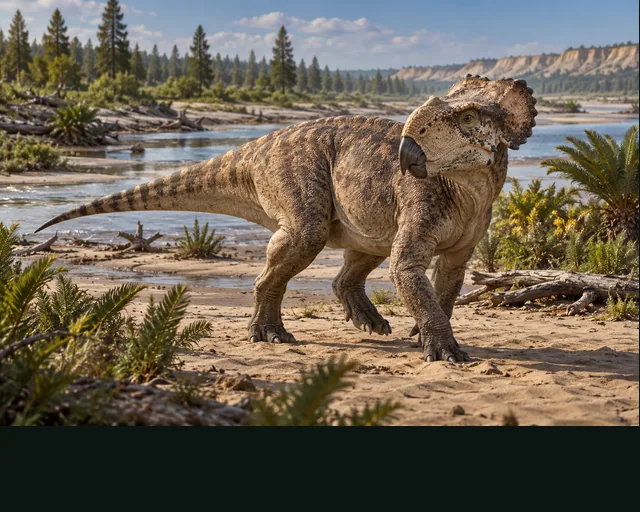
Our image follows Nobu Tamura’s complete restoration, which uses a two-legged pose with short forelimbs and a long tail. The pose is retained as an artistic interpretation. We do not claim that the picture establishes its usual gait, running speed or behaviour.
What about the bristles?
The tail covering and colours also come from the reference artist’s interpretation. They are not presented as Cerasinops bristles preserved with the fossils. Recognising this difference lets you enjoy the living reconstruction while asking which details are actually known.
Compare Protoceratops and Leptoceratops, then browse the C directory.
Quick answers
- Where was Cerasinops found?
- Its fossils come from the Two Medicine Formation of Montana, in the Late Cretaceous.
- Did it have Triceratops-like horns?
- It was an earlier-branching ceratopsian with a different head plan, not a miniature copy of Triceratops.
- Did it always walk on two legs?
- The original study discussed evidence for possible bipedality. A pictured pose alone cannot establish its usual locomotion.
- Are the tail bristles confirmed fossils?
- The bristles follow Nobu Tamura’s complete artistic reference and are not claimed as preserved Cerasinops bristles.