Jurassic Dinos editorial · Updated · Source-based review
What was Gonkoken?
Gonkoken was a plant-eating duck-billed dinosaur from far southern Chile. Its species Gonkoken nanoi was described in 2023 from the Magallanes region. The fossil-bearing record belongs to the early Maastrichtian, near the end of the Cretaceous.
Its discovery was important because it did not fit a simple picture in which every late-surviving duck-billed dinosaur belonged to Hadrosauridae. The original analysis placed Gonkoken close to that family but outside it.
How can a duckbill be outside Hadrosauridae?
Duck-billed is a descriptive term, while Hadrosauridae is the name of a particular evolutionary group. Some close relatives shared a broadly similar feeding apparatus without belonging inside that narrower family.
This distinction helps explain why Gonkoken matters. Its anatomy combined features used to investigate the branching relationships around hadrosaurid origins. A familiar outline does not erase those differences or turn every similar animal into the same taxon.
What does relict survival mean?
The study proposed that ancestors of Gonkoken reached South America earlier than the more derived hadrosaurids and persisted in far southern regions. In that explanation, they survived after comparable non-hadrosaurid duckbills had disappeared from the better-known North American record.
A relict population is a remaining part of a lineage once distributed more widely or represented elsewhere. It need not be primitive in the sense of being poorly adapted. Surviving in a particular region is itself part of an evolutionary history, not a failure to become another animal.
Does the discovery identify Antarctic fossils automatically?
No. The authors suggested that fragmentary duckbill fossils from southern regions deserve re-examination. Material once assumed to represent hadrosaurids might belong to close relatives instead.
That is a testable proposal. Each fossil still needs its own anatomical comparison, age assessment and provenance. It would be incorrect to relabel every isolated southern bone as Gonkoken simply because the genus is now known from Chile.
Reading the reconstruction
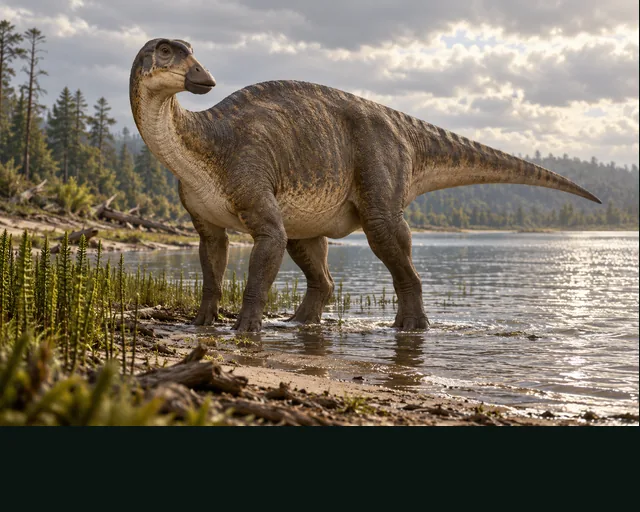
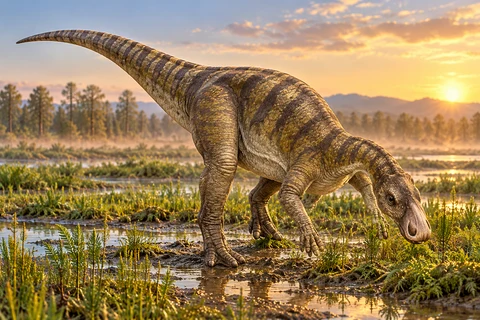
Our image follows a complete Gonkoken reference with a broad low head, deep torso, four-legged stance and long tapering tail. The stripe pattern, skin and precise back contour remain artistic interpretations.
Far southern latitude also should not be confused with a photograph of today’s Chilean climate. The landscape in the image is an independently designed scene, not evidence that this dinosaur lived in permanent snow or alongside modern animals.
Compare Hadrosaurus and Gilmoreosaurus, or explore the G directory.
Quick answers
- Where did Gonkoken live?
- In the Magallanes region of Chile, in far southern South America.
- Was it a hadrosaurid?
- The original analysis placed it close to, but outside, Hadrosauridae.
- What does relict mean here?
- A surviving population of a lineage whose relatives had disappeared from other regions.
- Does it prove every Antarctic duckbill was Gonkoken?
- No. The paper proposed reconsidering fragmentary southern fossils; it did not identify all of them as this genus.