Jurassic Dinos editorial · Updated · Source-based review
What was Gilmoreosaurus?
Gilmoreosaurus was a plant-eating dinosaur from the Late Cretaceous of Asia. Its best-established species is Gilmoreosaurus mongoliensis, known from the Iren Dabasu Formation record of what is now Inner Mongolia, China.
It belongs to the hadrosauroid story, which includes the familiar duck-billed dinosaurs and some of their close relatives. Hadrosauroidea is broader than the more restricted family Hadrosauridae. Using those names carefully helps explain why a duck-bill-like animal need not occupy the same branch as every later hadrosaurid.
Was a complete skeleton available?
The detailed 2010 redescription by Albert Prieto-Márquez and Mark Norell examined separated skull and body bones representing at least four individuals. These specimens collectively supply information, but they should not be described as one perfectly connected skeleton.
When several individuals are involved, researchers must determine which elements overlap and whether differences could reflect size, preservation or distinct taxa. A composite reconstruction can be useful, provided its assembly is not confused with the way the fossils were discovered.
How was it distinguished from Bactrosaurus?
The study confirmed differences using several regions, including jaws, teeth and parts of the pelvis. It also revised the diagnosis, the combination of characters used to identify the species.
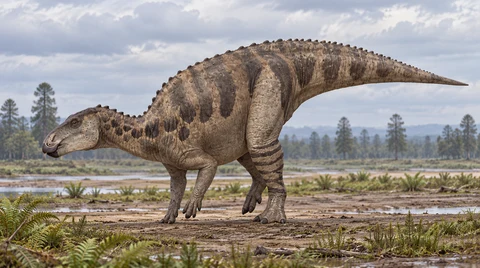
That is stronger than separating animals because one portrait has stripes and another does not. Colour patterns in life artwork are not the characters used to establish these fossil names. Comparing multiple skeletal regions helps researchers test whether an apparent difference is consistent across the available material.
Where did the analysis place it?
The 2010 evolutionary analysis recovered Gilmoreosaurus close to, but outside, Hadrosauridae. It therefore helps investigate the anatomical steps and branching relationships around the origin of the more familiar duck-billed dinosaur family.
Outside a named family does not mean unimportant or unsuccessful. It describes a position in an evolutionary hypothesis. Researchers can revise the details when new fossils or new character comparisons become available.
Reading our life portrait
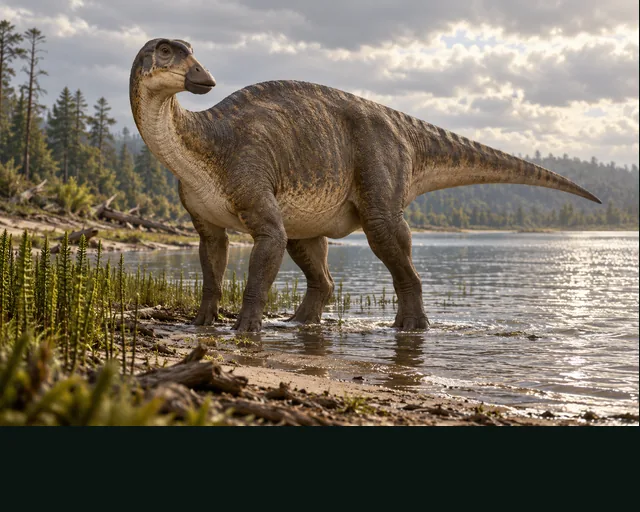
The approved complete reference shows several animals. Our portrait uses a single Gilmoreosaurus, retaining the broad beaked head, robust hindlimbs, smaller forelimbs and deep tapering tail of the foreground reconstruction.
The source’s group scene does not prove that the species nested or moved in that exact arrangement. Stripes, colours, skin texture and the lowered head pose are artistic choices. They introduce the animal visually without adding unsupported claims about its behaviour.
Compare Bactrosaurus and Hadrosaurus, or browse the G directory.
Quick answers
- What was Gilmoreosaurus?
- A plant-eating hadrosauroid close to the duck-billed dinosaur family.
- Was the studied material one complete skeleton?
- No. The redescription used separated bones representing several individuals.
- Is it another name for Bactrosaurus?
- The reviewed study confirmed anatomical differences between them.
- Does the reference group prove herding?
- No. The group in the source artwork is not direct behavioural evidence.