Jurassic Dinos editorial · Updated · Source-based review
What was Glyptodontopelta?
Glyptodontopelta was a plant-eating armoured dinosaur from the Late Cretaceous of New Mexico. It belongs to the ankylosaur story and was investigated as a nodosaurid in a detailed study of its armour.
The reviewed material came from the Naashoibito Member of the Ojo Alamo Formation in the San Juan Basin. The original species literature uses the spelling Glyptodontopelta mimus. Our account concerns that genus rather than creating separate animals from variations in a species ending.
How can armour identify an animal?
An osteoderm is a bone that forms in the skin. Some are plates, others have different outlines and surface textures. Their internal structure can also be investigated through histology, the study of tissues.
Michael Burns’s 2008 research examined a new specimen with a range of armour shapes and compared both external and internal features. The study concluded that the distinctive surface texture supported Glyptodontopelta as a valid taxon. A fragment need not be useless simply because it is not part of a complete articulated skeleton.
Why compare several armour shapes?
A plate near the neck may differ from one over the torso, even within a single animal. Comparing only one isolated shape risks confusing its position on the body with a difference between species.
A specimen preserving several forms gives researchers a better basis for testing those alternatives. However, this does not automatically reveal the exact arrangement of every plate across the living animal. A full-body portrait still requires an explicitly acknowledged reconstruction.
What happened to Edmontonia australis?
The study proposed that this species was a subjective junior synonym of Glyptodontopelta, based on similarities in particular armour. Subjective means that the relationship depends on a taxonomic interpretation rather than the names sharing exactly the same type specimen.
This does not rename the entire genus Edmontonia. Readers should keep the particular species involved attached to the proposal, instead of applying the change to every animal bearing the older genus name.
Reading the portrait
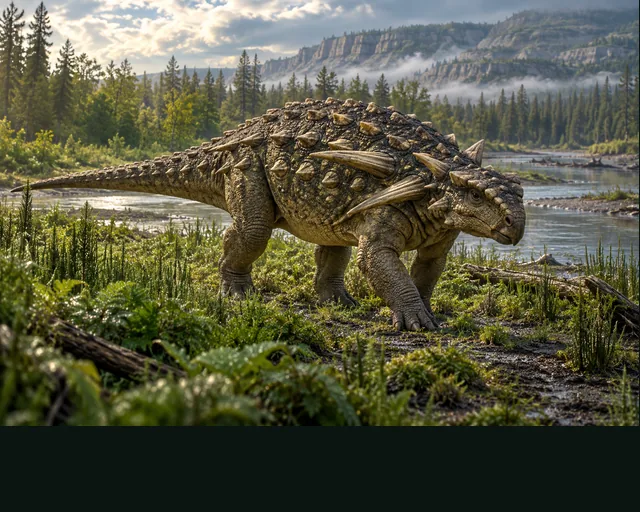
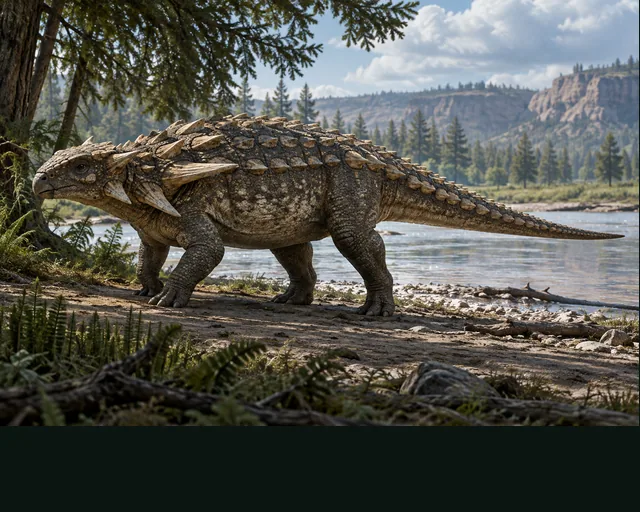
The complete approved reference supplied the low head, broad body, tapering unclubbed tail and interpreted armour layout. The final image keeps its lateral viewpoint, with far limbs hidden behind the near pair. An earlier view that exposed unsupported surfaces was rejected.
Head shape, much of the body, skin, colour and exact armour placement remain artistic. The picture does not convert those details into anatomical evidence from the fossil plates.
Compare Edmontonia and Sauropelta, then browse the G directory.
Quick answers
- What are osteoderms?
- Bones that develop within the skin and form part of the armour.
- Where was Glyptodontopelta found?
- In the San Juan Basin of New Mexico.
- Is its full body preserved?
- The reviewed evidence emphasizes armour, so much of a complete portrait remains interpreted.
- Did all Edmontonia become Glyptodontopelta?
- No. The reviewed synonym proposal concerned the species Edmontonia australis.