Jurassic Dinos editorial · Updated · Source-based review
What was Gandititan?
Gandititan was a long-necked, plant-eating sauropod from southern China. Fenglu Han and colleagues named Gandititan cavocaudatus in 2024. Its fossils were recovered in Ganxian County, Ganzhou, from the earlier part of the Late Cretaceous record.
The study identified it as a titanosaur. Titanosaurs were a diverse sauropod group, but the familiar word giant should not encourage readers to attach a record-breaking body size to every newly named member. This account does not assign an exact length or mass to the animal.
What parts of the skeleton were described?
The material includes an articulated neck series, parts of the back, and a sacrum connected with the front of the tail and part of the pelvis. The sacrum is the section of the backbone connected to the hips, helping link the trunk with the hindlimbs.
Connected bones are particularly informative because their order is preserved. A feature in the first part of the tail should be compared with the corresponding position in another dinosaur, rather than with whichever isolated vertebra happens to look most similar.
The described specimen is still partial. It does not provide a complete skull and all the limb bones needed to reconstruct every body proportion directly from this individual.
What made its backbone distinctive?
The original description identified a combination of features in the neck, sacrum and anterior tail. These include unusual depressions, ridges and projections. Such structures can be more useful for diagnosis than the overall long-necked outline shared by many sauropods.
A ridge on a vertebra need not form an equivalent ridge on the animal’s skin. Bone-level characters should not be converted automatically into visible external ornaments. They belong to an anatomical comparison whose purpose is to test identity and relationships.
Did it have relatives on another continent?
The study’s family-tree analysis placed Gandititan near several other titanosaurs and discussed possible connections between Asian and South American lineages. This provides a question for further research rather than a proven itinerary for an individual dinosaur.
To investigate dispersal, scientists must also consider the ages of fossils, changing geography and uncertainty in the evolutionary tree. A proposed relationship alone does not show when, where or how an ancestral population crossed between regions.
Reading the portrait
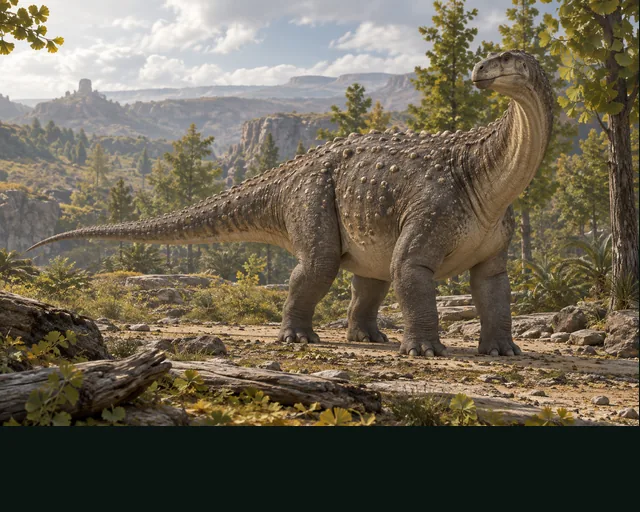
The approved complete reference guided the small head, rising neck, heavy torso and tapering tail. Skin pattern, exact posture and landscape are artistic. The portrait was not assembled by imagining missing anatomy from the partial fossil backbone.
Compare Saltasaurus and Andesaurus, then browse the G directory.
Quick answers
- Where was Gandititan found?
- In Ganxian County, Ganzhou, in southern China.
- Was its skeleton complete?
- No. The described material includes parts of the neck, back, sacrum, anterior tail and pelvis.
- Why are connected vertebrae useful?
- Their sequence helps researchers compare anatomical positions and changes along the backbone.
- Does its family tree prove a migration route?
- No. Relationships can suggest possibilities that must be tested with other evidence.