Jurassic Dinos editorial · Updated · Source-based review
Andesaurus was a long-necked plant-eating dinosaur from Patagonia, Argentina. It is especially important because researchers have repeatedly placed it near the early branches of Titanosauria. Titanosaurs were a diverse sauropod group, but understanding their history requires careful comparisons rather than calling every large Cretaceous sauropod the same thing.
A Patagonian fossil puzzle
Jorge Calvo and José Bonaparte introduced Andesaurus delgadoi in 1991. Their description discussed material from Neuquén and an Albian–Cenomanian geological context. That wording spans the boundary between the Early and Late Cretaceous, so “mid-Cretaceous” is a useful broad description here. It avoids pretending that the animal has one precisely established calendar date.
The defining specimen includes portions of the backbone, limbs and pelvis. These remains provide a substantial anatomical puzzle, but not a complete head-to-tail skeleton. Our page therefore does not offer a supposedly measured total length or body mass.
How do researchers recognise it?
Philip Mannion and Calvo redescribed the material in 2011. They identified five distinctive anatomical features, including details of back vertebrae, tail vertebrae and hand bones. Some of these features are subtle grooves or ridges that would not be obvious in a living animal’s silhouette.
A tall neural spine is a bony projection above a vertebra. The study described unusually tall projections on some back vertebrae. That does not, by itself, establish a dramatic skin sail or tell an illustrator exactly where the back’s soft-tissue outline should run. Fossil measurements and complete external appearance answer different questions.
The revision also concluded that other remains previously assigned to Andesaurus could not confidently be placed in this genus. Nearby fossils do not automatically belong to the same dinosaur. A reliable name depends on diagnostic comparisons, not simply a shared locality.
What does “early branching” mean?
An early branch on an evolutionary tree is not an unfinished animal. Andesaurus had its own combination of features and its own place in a functioning ecosystem. Its position helps researchers investigate which anatomical traits were present before later titanosaur groups diversified. The exact arrangement can still be tested with new data.
The image and the evidence
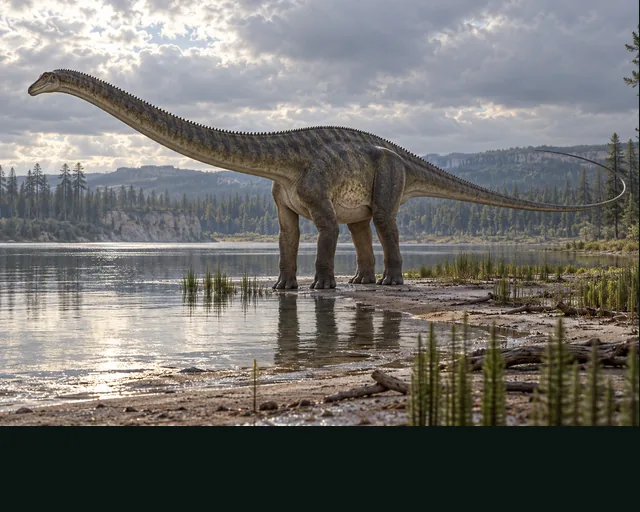
Our illustration follows Levi Bernardo’s complete named restoration: a small head, long neck, four supporting limbs and a slender tail. The source’s full-body interpretation supplies the visual reference; colour and soft tissues remain artistic.
Compare Argentinosaurus and Diplodocus, or continue through the A–Z directory under A.
Quick answers
- What group contained Andesaurus?
- It is generally interpreted as an early-branching titanosaur, within Sauropoda.
- Was the whole skeleton found?
- No. The defining material includes parts of the spine, limbs and pelvis.
- Was its back spine height the height of a skin sail?
- No. A measurement of a vertebral projection does not establish the outline of soft tissue.
- Can all nearby titanosaur bones be assigned to it?
- No. The 2011 revision rejected other previously referred material.