Jurassic Dinos editorial · Updated · Source-based review
What was Fruitadens?
Fruitadens was a very small dinosaur from the Late Jurassic of western North America. Its species, Fruitadens haagarorum, is known from the Morrison Formation record of Colorado. It belonged to the heterodontosaurids, an early branch of the ornithischian dinosaur family tree.
The animal is a useful reminder that dinosaur ecosystems included much more than giant predators and enormous long-necked plant eaters. Small species occupied their own places in those communities, even though their delicate fossils can be difficult to find and study.
How do researchers know it was not just a baby?
Body size alone cannot answer that question. The original study examined evidence of growth in the bones and interpreted the largest studied specimens as young adults. That supported the conclusion that a small skeleton need not belong to the hatchling of a much larger dinosaur.
Bone tissue can preserve a history of growth. Researchers compare that evidence with other anatomical clues rather than assuming that every small individual had reached its final size. This distinction is essential when investigating the lower limits of dinosaur body size.
What was unusual about its mouth?
Heterodontosaurids had different kinds of teeth rather than one uniform row. The Fruitadens diagnosis includes a small tusk-like tooth in the lower jaw and other distinctive dental features. Its teeth and jaws were not simply a miniature copy of those in every other member of the group.
A detailed 2012 study used micro-CT imaging and comparisons of jaw mechanics. It proposed that Fruitadens could bite rapidly at relatively wide mouth openings, unlike the stronger closing action inferred for some older heterodontosaurids at narrower gapes.
What might it have eaten?
The researchers interpreted it as a possible generalist, selecting plant material and perhaps insects or other invertebrates. That is a hypothesis drawn from anatomy and mechanics. It is not the same as discovering an insect preserved in this animal’s stomach.
An animal’s ability to process a food also does not establish how often it ate that food. This account therefore explains the proposed mixed diet without presenting a complete, certain menu.
Reading the life reconstruction
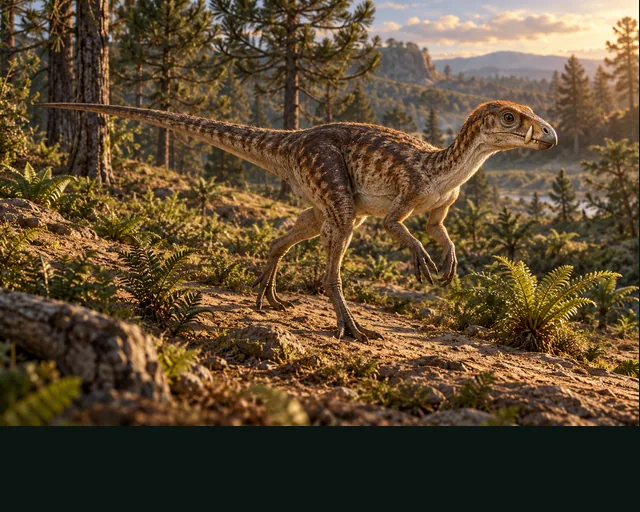
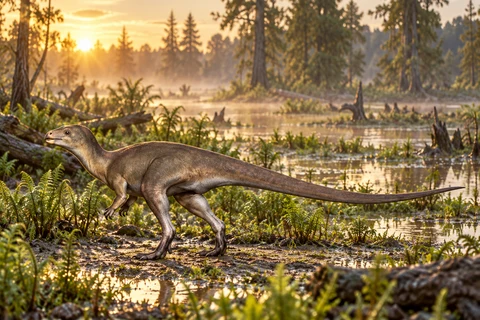
The approved complete reference supplied the compact body, short forearms, small beaked head and long tapering tail. The back filaments visible in that reference are speculative; their appearance does not establish that Fruitadens itself preserves that covering. Colour and pose are artistic as well.
Compare Heterodontosaurus and Echinodon, or explore the F directory.
Quick answers
- Was Fruitadens simply a hatchling?
- The larger studied individuals showed bone-growth evidence of young adulthood.
- What group did it belong to?
- Heterodontosaurids, an early branch of ornithischian dinosaurs.
- Did it eat insects?
- Researchers proposed that possibility from anatomy; the account does not treat it as a directly observed meal.
- Are the back filaments proven?
- No. The approved reconstruction uses speculative filaments.