Jurassic Dinos editorial · Updated · Source-based review
What was Efraasia?
Efraasia was a plant-eating sauropodomorph from Late Triassic Germany. Its species is Efraasia minor. The fossils belong to the Löwenstein Formation record, in the Norian interval.
Sauropodomorphs include the ancestors and relatives of the later giant sauropods, but an early member should not be treated as a miniature Diplodocus. Its body plan belongs to an earlier part of the group’s evolution, before the familiar enormous four-legged forms dominated many later landscapes.
Why was its classification complicated?
Historical collections placed several German specimens under names including Sellosaurus. A 2003 study compared the material specimen by specimen and found that the variation was not best explained by one taxon.
The analysis supported recognising Efraasia minor separately from material assigned to Plateosaurus gracilis. That result does not mean every fossil ever labelled Sellosaurus should now be called Efraasia. Individual specimens and the name-bearing types must be followed carefully through the revision.
Which features helped distinguish them?
The reviewed study examined differences involving teeth, skull anatomy, the sacrum, tail vertebrae and pelvis. The sacrum is the region connecting the backbone with the hips. Combining several body regions gives researchers more information than comparing a single general silhouette.
This approach also helps test whether differences reflect growth, ordinary variation or separate lineages. A specimen-based analysis keeps the actual fossil evidence visible instead of treating a traditional collection label as an unquestionable answer.
What did it eat?
Efraasia is interpreted as herbivorous. A later mechanical comparison examined its jaws alongside those of other dinosaurs and discussed features consistent with feeding on vegetation. Such work models function from anatomy; it does not measure the bite of a living Triassic animal.
That broad interpretation does not establish its favourite plant, exact daily intake or every feeding movement. A long neck and clawed hand can be interesting parts of the body without providing a complete record of everyday behaviour.
Reading our reconstruction
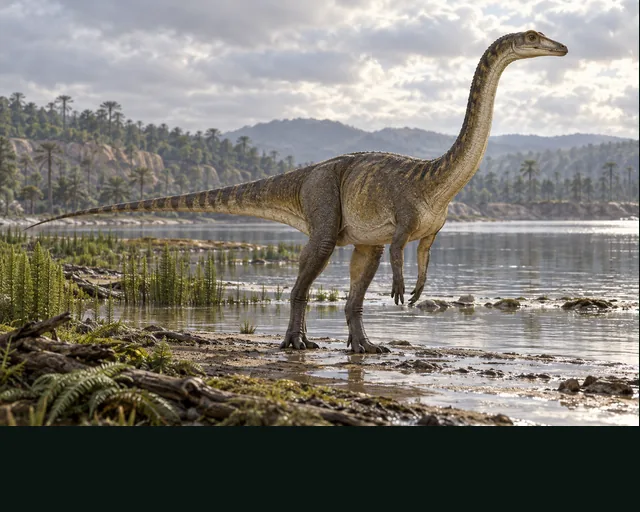
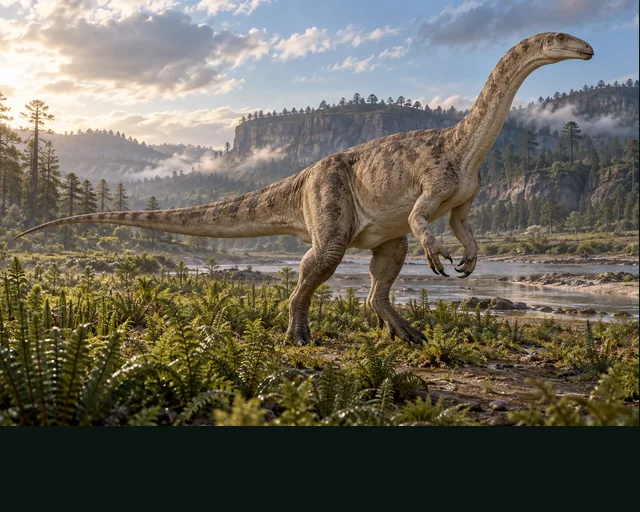
The picture follows a complete reference explicitly identified as Efraasia minor. It retains the small head, curved neck, clawed forelimbs, substantial hindlimbs and full curving tail. The colours, dorsal covering and detailed proportions remain artistic interpretations.
In particular, the portrait is not used to turn a potentially immature specimen into a definite adult size. Nor is Efraasia labelled the direct ancestor of a named later sauropod. The image offers a living outline while the article explains the specimen comparisons that make the name meaningful.
Compare Plateosaurus and Massospondylus, then browse the E directory.
Quick answers
- When and where did Efraasia live?
- In Late Triassic Germany, in the Norian Löwenstein Formation record.
- Was it a giant sauropod?
- It was an earlier-branching sauropodomorph, not simply a small version of a later giant sauropod.
- Why does the name Sellosaurus appear in its history?
- Material previously grouped under Sellosaurus was re-examined and separated into distinct taxa.
- Can the image establish its adult size?
- No. Reconstructed proportions and growth-related variation do not give a direct adult measurement.