Jurassic Dinos editorial · Updated · Source-based review
What was Dzharacursor?
Dzharacursor was an ornithomimid theropod from Late Cretaceous Uzbekistan. Its species is Dzharacursor bissektensis. The fossils come from the Bissekty Formation, within the Turonian interval.
Ornithomimids are often called ostrich-like dinosaurs because their reconstructions have relatively small heads, long necks and long legs. That comparison is a visual introduction, not a claim that they were modern ostriches or shared every part of an ostrich’s lifestyle.
Why does the animal have a new genus name?
The species had previously been assigned, with a question mark, to Archaeornithomimus. In a study published online in 2025, Alexander Averianov and Hans-Dieter Sues established Dzharacursor for the material.
The question mark in an older assignment signals uncertainty. A later reassessment can examine that uncertainty using more specimens and comparisons. Changing the genus does not create an extra species to count alongside the same historical fossil under its old name.
Were all the bones one skeleton?
The reviewed study discusses cranial elements and many isolated postcranial bones. Cranial means belonging to the skull; postcranial refers to the rest of the skeleton. This is a different evidence set from finding one complete articulated animal.
Researchers must consider which isolated remains can be assigned together and how their features vary. The article therefore does not describe the completed body in our image as a complete skeleton excavated in that pose.
Why are growth and variation important?
The study identified substantial growth-related variation and some individual variation. It also found that certain features previously proposed as distinctive in other ornithomimids varied within the material examined here.
A useful diagnosis must distinguish a lineage from changes caused by age or ordinary differences between individuals. This is why one unusual-looking bone should not automatically receive a new name. Comparing several equivalent elements can test whether the feature is truly consistent.
What does the family-tree analysis suggest?
The analysis placed Dzharacursor near the early branches of the ornithomimid radiation, while more derived than Archaeornithomimus. That is a relationship hypothesis based on anatomy, not a ranking from unsuccessful to successful animals.
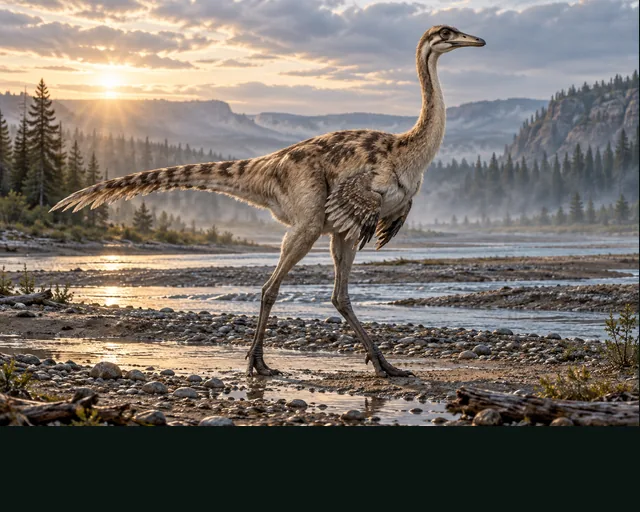
Our illustration follows a complete reference specifically labelled Dzharacursor bissektensis. It retains the small beaked head, short feathered forelimbs, long hindlimbs and feathered tail. The covering, colours and pose remain artistic interpretations. Neither the running-related name nor the long-legged portrait establishes an exact speed, diet or social behaviour.
Compare Ornithomimus and Gallimimus, then explore the D directory.
Quick answers
- Where was Dzharacursor found?
- In the Bissekty Formation of Uzbekistan.
- Was it a troodontid?
- No. The reviewed naming study identifies it as an ornithomimid.
- Why did its genus name change?
- The study reassessed material previously called Archaeornithomimus(?) bissektensis.
- Does a running-related name establish speed?
- No. Its name and long-legged portrait are not a measured running record.