Jurassic Dinos editorial · Updated · Source-based review
What was Duonychus?
Duonychus was a therizinosaur from Late Cretaceous Mongolia. Its species is Duonychus tsogtbaatari, described in 2025. The fossil comes from the Bayanshiree Formation, which has yielded several kinds of dinosaurs.
Therizinosaurs belong within Theropoda, the branch often associated with meat-eating dinosaurs. Yet this lineage developed a very different body plan and is generally interpreted as plant-eating. Duonychus adds a particularly unusual hand to that evolutionary story.
Why are two fingers remarkable?
The animal had two functional clawed fingers on each hand. Many familiar therizinosaurs have three. Losing a finger changes the arrangement of the hand, but it does not necessarily make the remaining fingers ineffective.
Tyrannosaurs also provide familiar examples of two-fingered hands. That resemblance does not make Duonychus a tyrannosaur or imply that the hands served identical purposes. Similar changes can evolve independently in separate lineages, a pattern called convergence.
What was preserved around the claw?
The study described a three-dimensional keratinous sheath on a first hand claw. Keratin is the material that forms structures such as modern claws and nails. The outer sheath is different from the bone that supports it.
Many dinosaur claws are represented mainly by that underlying bone. Preserving the covering therefore provides another kind of information about the living structure. It also reminds us that a bare fossil bone does not always reproduce the complete outline of the part visible in life.
What might the hands have done?
The researchers considered the strongly curved claws and their capacity for flexion. Those features supported a proposal that the hands could grasp plant material effectively, even with only two fingers.
This remains a functional interpretation. It is not a directly observed feeding event, a measured grip force from a living animal or proof of a favourite plant. Long claws alone should not be used as a shortcut to declaring an animal a predator.
Reading our reconstruction
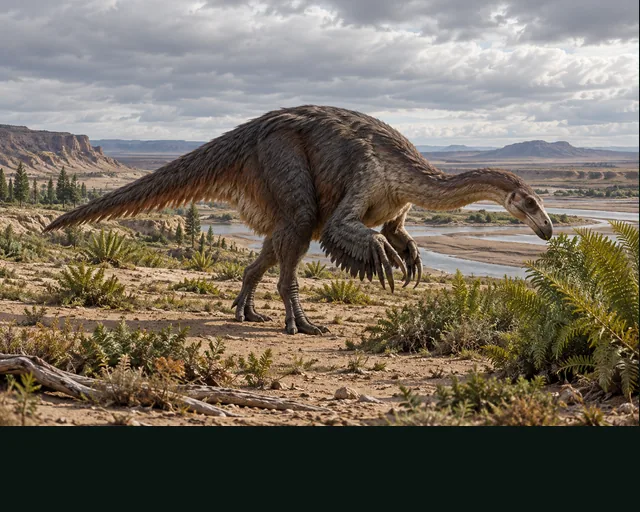
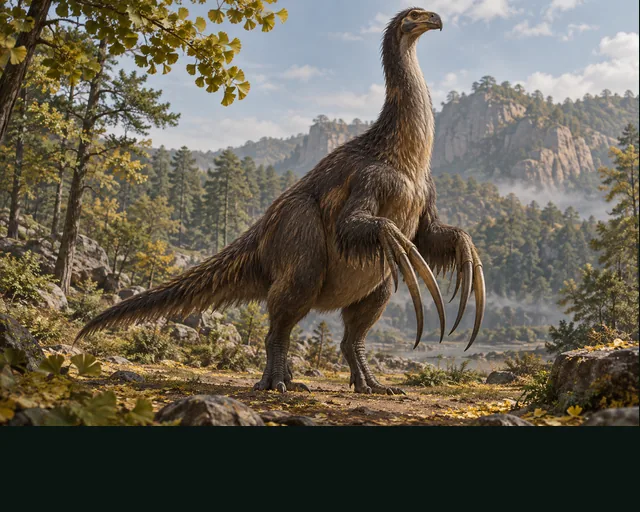
Our portrait follows Connor Ashbridge’s complete reference explicitly identified as Duonychus. Its long neck, small beaked head, feathered body and long forearms provide the visual framework. Each illustrated hand retains exactly two distinct clawed fingers.
The colours, detailed covering, soft tissues and setting remain artistic interpretations. The image does not establish a complete preserved skull or an exact body size. Its carefully counted fingers help introduce the feature, while the sources explain why the fossil claw covering and evolutionary comparison matter.
Compare Therizinosaurus and Segnosaurus, then explore the D directory.
Quick answers
- How many fingers did Duonychus have?
- It had two functional clawed fingers on each hand.
- Was it a tyrannosaur?
- No. It was a therizinosaur; similar finger counts evolved in separate theropod branches.
- What was unusual about the claw fossil?
- It preserves a three-dimensional keratinous covering rather than only the supporting bone.
- Do long claws prove meat-eating?
- No. The study interpreted the hands as potentially useful for grasping plant material.