Jurassic Dinos editorial · Updated · Source-based review
What was Drusilasaura?
Drusilasaura was a plant-eating titanosaurian sauropod from Patagonia. Its species is Drusilasaura deseadensis, named by César Navarrete, Gabriel Casal and Rubén Martínez in 2011. The fossils come from northern Santa Cruz in Argentina.
The discovery adds to the diversity of South American long-necked dinosaurs. However, a complete artistic sauropod is not the same thing as a complete discovered skeleton. Understanding this animal begins with the particular bones described in the study.
Which parts were preserved?
The naming material includes vertebrae from the back, hip and tail regions, a left scapula and fragments of ribs and other bones. The scapula is the shoulder blade. Different parts of the backbone can preserve different characters, so their positions must be identified carefully.
A tail vertebra should not be compared with a neck vertebra as though they were equivalent structures. Anatomical work involves recognising the element, its orientation and its place in the skeleton before deciding what its features reveal.
Why can vertebrae distinguish a dinosaur?
Vertebrae contain surfaces, ridges and spaces that vary among sauropods. Researchers compare their combinations with corresponding bones in other animals. Those differences can support a diagnosis even where a skull or complete limb is missing.
The original description interpreted Drusilasaura as a titanosaur. A narrower relationship hypothesis requires further comparison and should not be treated as settled merely because another Patagonian giant has a similar outline in a picture.
What does the formation tell us?
The remains were described from the upper part of the Bajo Barreal Formation. The reviewed study places them in the Late Cretaceous. A formation is a geological unit whose layers must be investigated in their own context.
Dates established for a different Argentine formation cannot simply be copied onto these fossils. Sharing a country or the broad label Cretaceous does not mean two dinosaurs lived at exactly the same time. This page therefore avoids an unchecked exact age or a scene involving a supposedly certain contemporary.
Reading our long-necked portrait
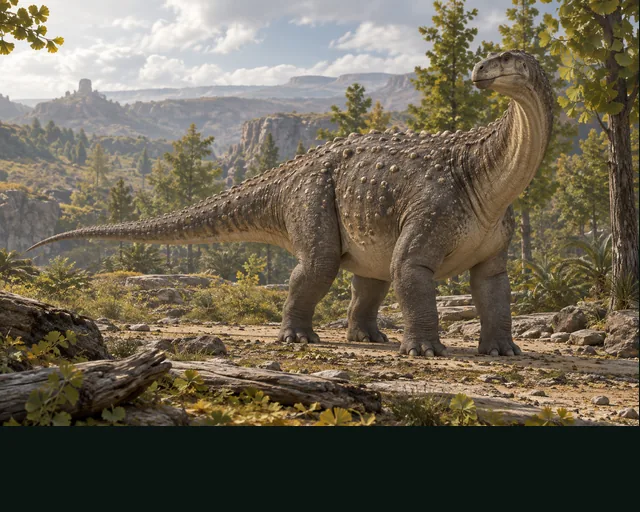
The illustration follows a complete reference specifically identified as Drusilasaura. It retains the small head, very long raised neck, substantial four-legged body and tapering tail. The low dorsal ridge belongs to the reference artist’s completion.
That ridge is not presented as preserved skin armour, and the image does not establish the exact shape of an undiscovered skull. The orange colours, soft tissues and posture remain artistic interpretations. The portrait offers a whole-animal introduction while the sources explain the backbone evidence behind the scientific name.
Compare Saltasaurus and Argentinosaurus, then explore the D directory.
Quick answers
- Where was Drusilasaura found?
- In northern Santa Cruz, Patagonia, Argentina.
- What fossils are known?
- The naming material includes parts of the backbone, ribs and a shoulder blade.
- Was it a titanosaur?
- The original description identified it as a titanosaurian sauropod.
- Is the dorsal ridge directly preserved skin?
- No. It follows the complete artistic reference and is not claimed as fossil skin.