Jurassic Dinos editorial · Updated · Source-based review
What was Dracovenator?
Dracovenator was a theropod dinosaur from Early Jurassic South Africa. Its species is Dracovenator regenti, described by Adam Yates in 2005. The fossils come from the upper Elliot Formation, part of the important southern African record of early dinosaurs.
Its predatory interpretation belongs to a wider investigation of early theropod evolution. At that time, different lineages combined features in ways that do not always fit the familiar categories used for much later dinosaurs.
How much of the animal is known?
The naming description is based on a fragmentary skull. Particular features of the premaxilla and the rear part of the lower jaw helped distinguish it. The premaxilla is a bone near the front of the upper jaw; the jaw joint lies much farther back.
These regions can preserve useful characters even without a complete head. A distinctive groove, depression or process can contribute to a diagnosis when it is compared carefully with equivalent structures in other animals. A fossil does not have to be a complete mounted skeleton to be informative.
Why compare it with Dilophosaurus?
The original analysis suggested a relationship involving Dracovenator, Dilophosaurus and Zupaysaurus. However, the study also noted that this particular grouping was not robustly supported. The result should therefore be described as a hypothesis rather than an uncontested family assignment.
Comparisons can help interpret evolution, but they do not authorise filling every missing part with the appearance of a famous relative. Especially dramatic structures, such as cranial crests, need their own evidence. We do not give Dracovenator a large Dilophosaurus-style crest merely because the genera were compared in a paper.
What does a mixture of traits mean?
The skull combines features compared with relatively early theropods and features seen in more derived forms. Such a mosaic can help researchers investigate when different anatomical changes occurred.
Evolution does not replace every part of an animal at once. A lineage can retain some older states while acquiring other features. The pattern is reconstructed from many comparisons, and incomplete specimens leave some alternatives difficult to separate.
Reading our illustration
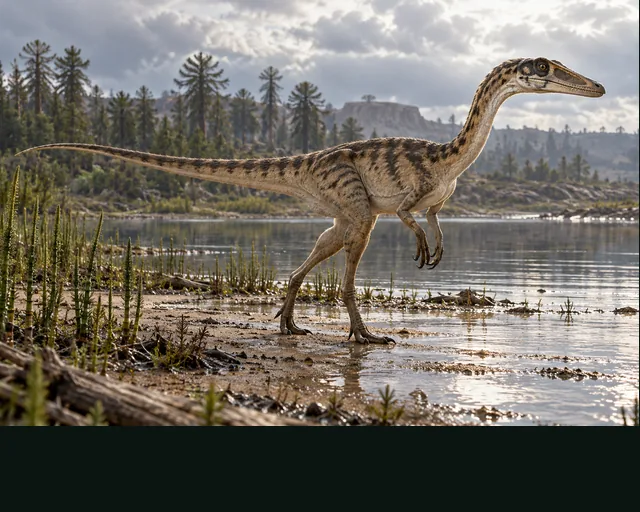
The whole-animal picture follows a complete reference explicitly identified as Dracovenator regenti. Its low crest outline, toothed head, short forelimbs and raised tail remain within that reference’s visual interpretation. No isolated fossil image is used to invent a missing body.
The completed crest, soft tissues, spotted colours and body proportions are artistic. They are not presented as an intact discovered skull or complete skeleton, and the running pose does not establish an exact speed or hunting method.
Compare Dilophosaurus and Coelophysis, then explore the D directory.
Quick answers
- Where was Dracovenator found?
- In the upper Elliot Formation of South Africa.
- What fossil material established it?
- A fragmentary skull, including informative jaw regions.
- Was it certainly a close relative of Dilophosaurus?
- The original analysis suggested that connection, but the exact grouping was not robustly supported.
- Was its entire crest discovered?
- The completed crest in the approved artistic reference is not presented as an intact discovered crest.