Jurassic Dinos editorial · Updated · Source-based review
What was Dracoraptor?
Dracoraptor was a small theropod dinosaur from Early Jurassic Wales. Its species is Dracoraptor hanigani, named in 2016. The fossils were found at Lavernock Point, near the coast of southern Wales, in rocks belonging to the Blue Lias succession.
Its name evokes a dragon, but the animal was a dinosaur rather than a mythical creature. It contributes to the record of early Jurassic theropods, an interval in which many important evolutionary questions still depend on relatively scarce remains.
How was it discovered?
Nick and Rob Hanigan found fossil-bearing blocks after material had fallen from the cliff in 2014. The remains were later studied and donated to the National Museum Wales collections. Keeping the original specimen in a documented collection allows other researchers to examine the evidence.
The skeleton is partial and disarticulated, meaning the bones are not all preserved in their original connected positions. It includes skull material as well as other skeletal regions. That makes it informative without making it a complete animal.
How can fallen blocks be dated?
When a fossil is collected loose, researchers must investigate which layer it came from. The original study compared the blocks’ rock characteristics with the exposed cliff sequence and its stratigraphic markers.
Those markers include fossils and boundaries used to correlate geological layers. The reviewed work placed the dinosaur in the Hettangian, near the beginning of the Jurassic. The bed assignment was reasoned from evidence rather than read from a label attached to the living animal.
Why was a land animal in marine rocks?
The enclosing strata formed in a marine setting. A terrestrial animal’s remains can reach the sea before burial, so that setting does not establish a swimming lifestyle. Burial environment and everyday habitat are related questions, but they are not identical.
This is a useful distinction when comparing dinosaurs with genuinely marine reptiles. Sharing a fossil deposit does not make every animal in it adapted to the same way of life.
Reading the restoration
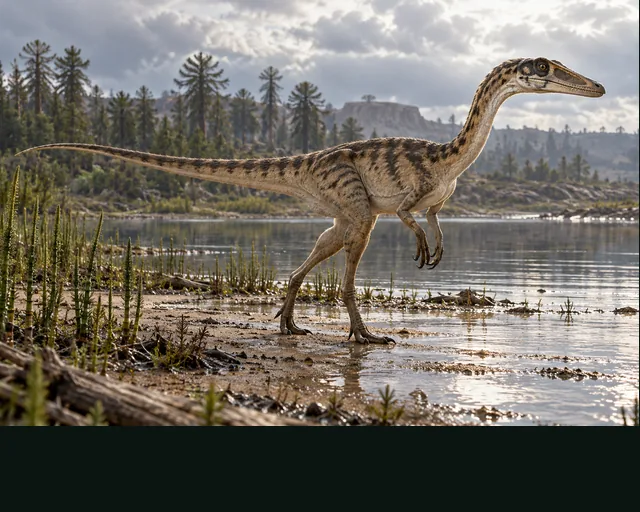
Our image follows a complete Dracoraptor reference created in a juvenile context. It retains the small head, long neck, grasping forelimbs, long hindlimbs and tapering tail. The featherlike covering and red extremities remain artistic interpretations, not directly preserved plumage or colour evidence.
The illustrated proportions should not be turned into an exact adult size. Likewise, a single pose does not establish a known running speed or social behaviour. The portrait introduces the animal while the sources explain the geological detective work behind its discovery.
Compare Coelophysis and Dilophosaurus, then explore the D directory.
Quick answers
- Where was Dracoraptor found?
- At Lavernock Point in southern Wales.
- Who discovered the main remains?
- Nick and Rob Hanigan found fossil-bearing fallen blocks in 2014.
- Was it a marine reptile?
- No. Burial in marine strata does not make a theropod a sea-dwelling reptile.
- Are its feathers directly preserved?
- The covering follows the approved artistic restoration and is not claimed as fossil feather evidence.