Jurassic Dinos editorial · Updated · Source-based review
What was Draconyx?
Draconyx was a plant-eating dinosaur from Late Jurassic Portugal. Its species is Draconyx loureiroi, originally described in 2001. The fossils come from the Lourinhã Formation, a rock unit important for studying European Jurassic vertebrates.
It belongs to the iguanodontian branch of ornithopods. The name may sound like a predatory dragon, but a dramatic name does not determine an animal’s diet or evolutionary group.
Why look at its hands again?
A 2022 reappraisal examined previously unreported hand elements belonging to the holotype, ML357. The holotype is the specimen that anchors the scientific name. New information about that specimen can improve a description without requiring the discovery of an entirely new animal.
The researchers used CT scanning and anatomical comparisons to investigate the preserved structures. Hands contain several small elements, and their arrangement can provide useful evidence even when they are less spectacular than a large skull or tail.
Did all referred material stay with the genus?
No. The study reassigned a previously referred specimen, ML434, to indeterminate Ankylopollexia. Indeterminate means the material can be placed in a broader group without confidently assigning it to a particular genus.
This distinction prevents an animal’s description from becoming artificially complete. A bone once associated with Draconyx should not continue supplying measurements or identifying features after a revision has questioned that assignment.
Where does it fit among plant-eaters?
The reappraisal supported placing Draconyx within Styracosterna. That branch contains several well-known iguanodontian herbivores. The study also acknowledged limited support for some detailed relationships near the base of the group.
An older family label should therefore not be treated as a permanent consensus. Scientific classifications depend on the characters and specimens examined. Rechecking a historic fossil can change a relationship hypothesis while also making its diagnosis more precise.
What can we say about movement?
Body proportions can contribute to interpretations of stance and locomotion. However, an illustrated step is not a directly observed gait, and a relatively small skeleton does not establish an exact running speed. Functional questions require their own evidence and assumptions.
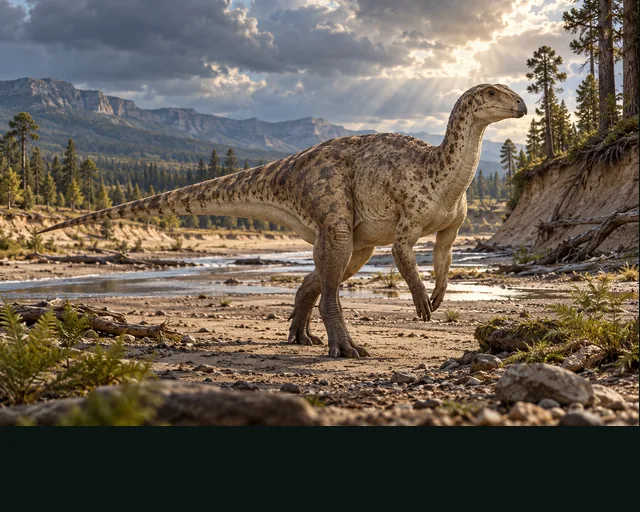
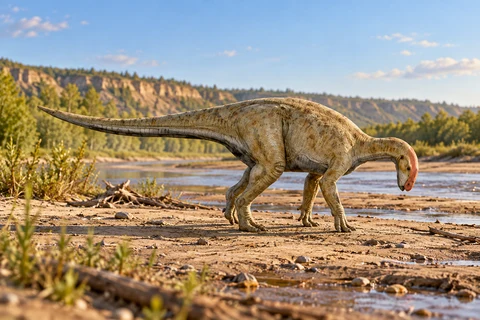
Our picture follows a complete restoration specifically identified as Draconyx loureiroi. It retains the low beaked head, deep trunk, small dorsal ridge and full long tail. The orange stripes, surface bumps and soft tissues remain artistic decisions. They are not preserved colours or proof of an armoured back. The whole-animal view is paired with the publication record so the hand evidence and the finished portrait remain distinguishable.
Compare Camptosaurus and Cumnoria, then browse the D directory.
Quick answers
- Where did Draconyx live?
- It is known from the Late Jurassic Lourinhã Formation of Portugal.
- What new evidence was studied?
- Previously unreported hand elements belonging to the naming specimen.
- Does every referred bone remain Draconyx?
- No. The reappraisal removed a previously referred specimen from the genus.
- Are the orange stripes fossil evidence?
- No. They follow the approved complete artistic reference.