Jurassic Dinos editorial · Updated · Source-based review
What was Cumnoria?
Cumnoria was a plant-eating dinosaur from Late Jurassic England. Its species is Cumnoria prestwichii. The fossils come from the Kimmeridge Clay Formation of Oxfordshire, making it part of the earlier history of the iguanodontian branch of ornithopods.
Iguanodontians eventually included many successful Cretaceous herbivores. Earlier members are important because they help researchers investigate how that diversity developed. A historical British specimen can contribute to this question even when it has already spent many years in a collection.
Why did its name need another look?
Cumnoria has had a complicated classification history and was previously associated with the North American genus Camptosaurus. A modern redescription, published online in 2023, examined its anatomy and evolutionary position again.
The study supported recognising Cumnoria as a distinct valid genus. Its conclusion was not based on the two animals having different country names. It identified anatomical evidence that could be compared in the fossils themselves.
What did the shoulders reveal?
Two distinctive features of the pectoral girdle helped support the diagnosis. The pectoral girdle is the region that supports the shoulders and connects the forelimb apparatus with the body. It may be less spectacular than a giant skull horn, but small differences in this region can still carry important information.
An autapomorphy is a distinctive derived character used to recognise a taxon. It must be assessed against other animals and against preservation. A general body outline cannot replace the detailed comparisons needed to identify such a feature.
Where does it fit in the family tree?
The reviewed analysis placed Cumnoria among early-branching iguanodontians outside the more specialised group Ankylopollexia. The technical label describes a relationship hypothesis, not a claim that Cumnoria was an unfinished or unsuccessful dinosaur.
Evolution does not arrange animals on a ladder from poor to perfect. A branch can retain some older character states while being well suited to its own environment. New fossils and revised comparisons may change the exact branching pattern without making the animal’s preserved anatomy disappear.
Reading our reconstruction
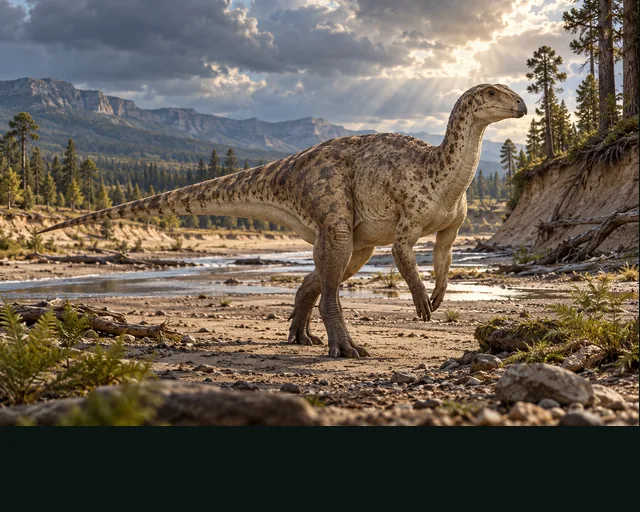
Our illustration follows a complete reference explicitly identified as Cumnoria prestwichii. It retains the small lowered head, bent neck, substantial hindlimbs and full tapering tail. That named reference, rather than an image of Camptosaurus, supplies the visual framework.
The pose, colours, skin texture and exact soft-tissue proportions remain artistic interpretations. They do not establish its habitual gait, preferred feeding height or social behaviour. Keeping the reconstruction separate from the diagnostic shoulder evidence helps explain both the appeal and the limits of a life portrait.
Compare Camptosaurus and Iguanodon, then browse the C directory.
Quick answers
- Where did Cumnoria live?
- Its fossils come from Late Jurassic Oxfordshire in England.
- Is Cumnoria simply Camptosaurus?
- The reviewed modern redescription supports a distinct valid genus.
- Which body region helped distinguish it?
- The pectoral girdle, the shoulder-supporting region, preserves two diagnostic features in the study.
- Does its pictured posture establish its gait?
- No. The low-headed whole-body pose remains an artistic restoration.