Jurassic Dinos editorial · Updated · Source-based review
What was Deltadromeus?
Deltadromeus was a slender theropod dinosaur from Morocco. Its species is Deltadromeus agilis. The fossils come from the Kem Kem record, in the Cenomanian part of the Late Cretaceous.
The animal is often pictured as a fast-moving predator. However, a familiar pose and an energetic name should not conceal the limits of the fossil evidence. Its partial skeleton and uncertain relationships make it a useful case for learning how reconstructions differ from discoveries.
Was a complete skull found?
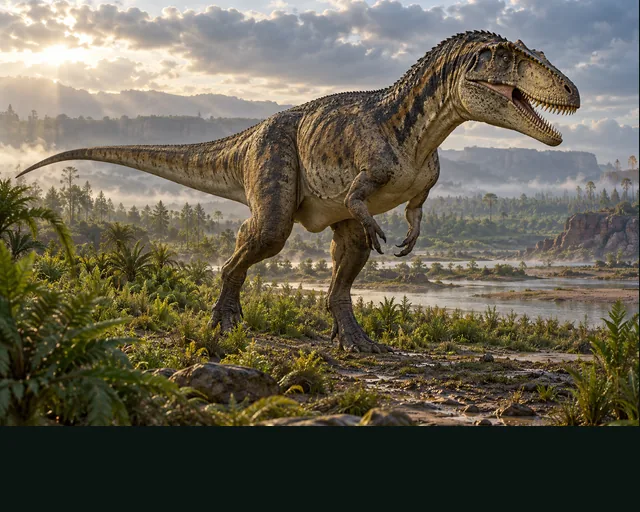
No skull was preserved in the material discussed by the reviewed synthesis. A completed head in an illustration is therefore an interpretation, not a portrait of an excavated skull.
The original 1996 paper also discussed Carcharodontosaurus, represented by a very large skull. Those are separate animals in the same publication. Transferring the impressive skull measurement from one paragraph to the slender skeleton in another would create an incorrect description of Deltadromeus.
Why has its classification changed?
The original study interpreted the slender skeleton as an early-branching coelurosaur. Later discussions considered noasaurid relationships. Those are different parts of the theropod family tree, illustrating how new comparisons can alter an initial hypothesis.
The broad identification as a theropod remains a useful starting point. A more precise placement depends on anatomical characters, not on whether a reconstruction resembles a particular familiar predator. Missing regions can make competing interpretations difficult to test.
What can its legs tell us?
Slender proportions provide information about the preserved body. They do not supply a directly measured running speed. Estimating performance requires assumptions about muscles, body mass, limb movement and other factors that are not fully visible in isolated bones.
The missing skull also limits direct feeding interpretation. This account does not assign a definite menu from the sharp-looking teeth of an artist’s reconstructed head. Those teeth are part of a completed visual hypothesis, rather than newly discovered evidence.
What was the Kem Kem setting?
The reviewed geological synthesis describes river and delta environments. Fossil preservation and collecting can favour certain body parts or animals, so the number of fossils found is not a simple census of every living creature.
Our illustration follows an approved complete Deltadromeus reference, retaining its low head, short forelimbs and long balancing tail. The curled tip, surface covering and colours remain artistic. The scene is an independent imagined setting and does not establish a documented hunt or encounter.
Compare Carcharodontosaurus and Spinosaurus, then browse the D directory.
Quick answers
- Where was Deltadromeus found?
- In the Late Cretaceous Kem Kem record of Morocco.
- Was its skull found?
- The reviewed synthesis notes that no part of the skull was preserved.
- Does its name prove a measured running speed?
- No. Slender proportions and a running-related name are not a speed measurement.
- Was its family placement always agreed?
- No. The original coelurosaur interpretation differs from later discussions of noasaurid affinities.