Jurassic Dinos editorial · Updated · Source-based review
What was Datousaurus?
Datousaurus was a plant-eating sauropod from Middle Jurassic China. Its species is Datousaurus bashanensis. Dong Zhiming and Tang Zilu named the genus in 1984, adding another animal to the fossil record of the Sichuan Basin.
The museum directory identifies it as a sauropod: a member of the long-necked dinosaur group with four weight-bearing limbs. Its fossils are associated with the Lower Shaximiao record of Sichuan. That regional setting matters more than an attractive image of a generic Jurassic giant.
How do you recognise a sauropod?
A long neck, substantial trunk and long tail provide an accessible starting point. However, many different sauropods share that general outline. Identifying a particular genus requires anatomical comparisons, rather than simply matching a silhouette to whichever familiar name comes to mind.
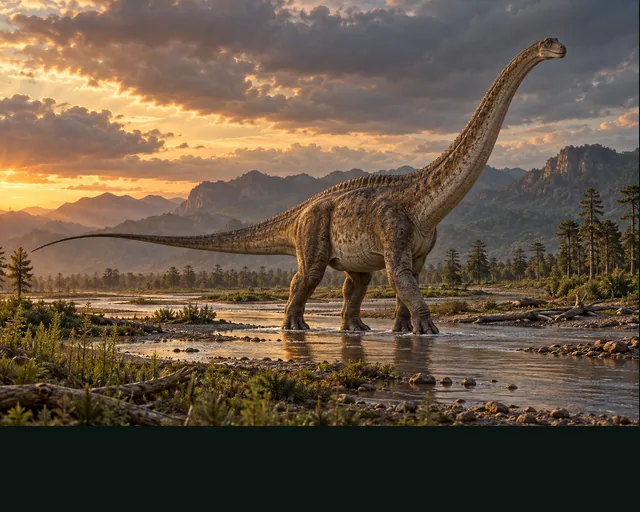
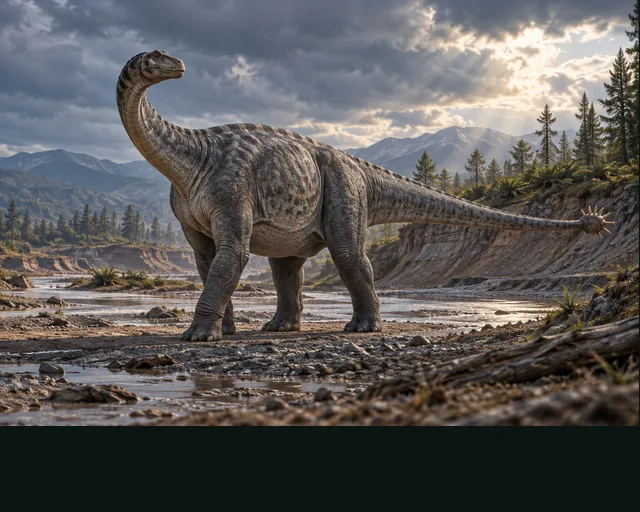
This is why a named reference is important for our illustration. We use a complete Datousaurus restoration rather than taking a picture of Omeisaurus or Shunosaurus and changing the label. The article and image serve different purposes: one explains the researched animal, while the other offers an interpreted whole-body view.
What does its geological setting tell us?
The Middle Jurassic places Datousaurus in a different chapter from the great Late Cretaceous dinosaur communities. A formation is a named body of rock, not a single instant of time. Fossils assigned to the same broad regional succession still require careful comparison of their horizons.
Consequently, this account does not put every Sichuan dinosaur into one certain encounter. Sharing a region or a broad time interval does not prove that two named animals stood beside each other, competed for the same branch or travelled in one herd.
What did it eat?
Datousaurus is interpreted as herbivorous. That supports a plant-eating lifestyle, but it does not establish a favourite plant or exact daily food intake. A long neck also does not, by itself, prove one habitual browsing height.
To investigate feeding more closely, researchers need appropriately identified anatomy and environmental evidence. The completed height and neck angle in a restoration should not silently become a measured ecological fact.
Reading our portrait
The approved complete reference shows a raised head, curved neck, broad body and a long tail curling away from the viewer. Our image retains those visual features. The tail loop is an artistic pose, not evidence that Datousaurus routinely carried its tail that way.
Its skin texture, colours and soft tissues also remain interpretations. Fossil rarity is not used here to declare the animal solitary: preservation and collecting affect how often an animal is found. The useful starting facts are its identity, region, age and sauropod relationships.
Compare Shunosaurus and Omeisaurus, then browse the D directory.
Quick answers
- Where did Datousaurus live?
- It is known from Middle Jurassic Sichuan in China.
- What did it eat?
- It was a sauropod interpreted as herbivorous.
- Who named it?
- Dong Zhiming and Tang Zilu named the genus in 1984.
- Does the curled tail show its usual posture?
- No. The image follows a complete artistic reference, and that pose is not a direct fossil observation.