Jurassic Dinos editorial · Updated · Source-based review
What was Dahalokely?
Dahalokely was a meat-eating dinosaur from northern Madagascar. Its species is Dahalokely tokana, named by Andrew Farke and Joseph Sertich in 2013. The fossils come from Turonian rocks in the Late Cretaceous.
The animal is interesting not because every part is known, but because it helps fill a poorly sampled interval in the island’s dinosaur history. A small amount of well-documented evidence can raise useful questions about a much larger evolutionary story.
What remains were discovered?
The naming material preserves part of the axial skeleton: the backbone and associated ribs. Researchers identified distinctive features of the vertebrae and used them in an anatomical comparison. A full skull, limbs and skin covering were not preserved as a complete animal.
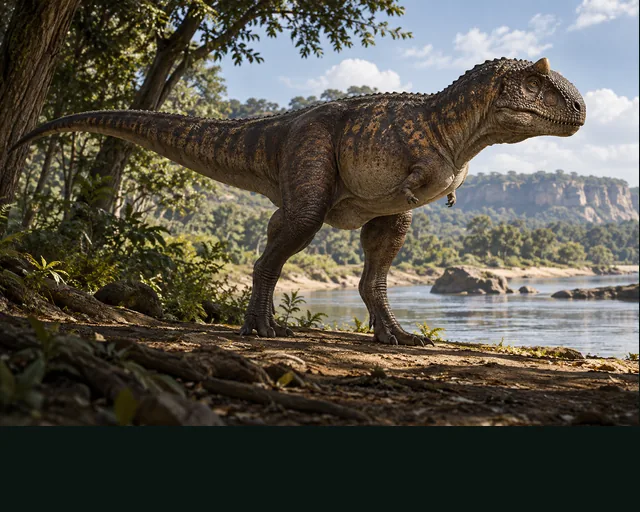
That limit matters when viewing a restoration. A complete living outline contains many choices beyond the surviving bones. Our picture follows an existing full-body artwork specifically identified as Dahalokely; it is not generated by interpreting a skeletal photograph or borrowing a different species’ illustration.
What kind of theropod was it?
The original analysis supported placing Dahalokely among abelisauroids. This broader branch includes several kinds of predatory dinosaurs, with important differences between its members. A narrower placement among noasaurids received weaker support in the study.
Weak support does not mean that every possible classification is equally likely. It means the available character sample did not firmly settle that more precise question. Additional overlapping material could help distinguish competing interpretations.
Why does ancient geography matter?
At the relevant time, India and Madagascar were associated in a landmass often called Indo-Madagascar. Their later separation changed the routes available to land animals. Fossils from different intervals can help researchers investigate how those changes influenced animal communities.
However, an animal living earlier in the same broad region is not automatically the direct ancestor of a later dinosaur. The original study explicitly recognised the need for more complete evidence to test Dahalokely’s connections with later abelisauroids. We therefore do not label it the proven ancestor of Majungasaurus.
Reading our image
The complete artistic reference supplies the deep head, reduced forelimbs and long tail seen in the portrait. Its red and dark covering, spotted pattern and soft-tissue proportions are interpretations, not preserved Dahalokely skin or colour.
The landscape also represents an imagined setting rather than a reconstructed photograph of one known habitat. The picture offers a whole-animal introduction while the source notes preserve the limited but valuable evidence on which the name is based.
Compare Majungasaurus and Noasaurus, then explore the D directory.
Quick answers
- Where was Dahalokely found?
- In northern Madagascar, in Turonian-aged Late Cretaceous rocks.
- Was a complete skeleton discovered?
- No. The naming material consists of parts of the backbone and associated ribs.
- Was it certainly an ancestor of Majungasaurus?
- No. A direct ancestral relationship is not established by the available remains.
- Are its red and black colours known?
- Those colours follow a complete artistic reference and are not preserved colour evidence.