Jurassic Dinos editorial · Updated · Source-based review
What was Crittendenceratops?
Crittendenceratops was a horned dinosaur from Late Cretaceous Arizona. Its species is Crittendenceratops krzyzanowskii. The fossils come from the Fort Crittenden Formation, whose name is also part of the dinosaur’s genus name.
It belonged to the ceratopsids, the large-bodied horned dinosaurs with beaks and bony frills. Within that group, the original study placed it among the centrosaurines, specifically the branch called Nasutoceratopsini. Those relationships were inferred from anatomical comparisons rather than a general resemblance in a life illustration.
What was discovered?
The 2018 naming study described partial cranial material from two individuals. Cranial means belonging to the skull. Both came from the same stratigraphic unit in southeastern Arizona, but they were not pieces of one complete skeleton.
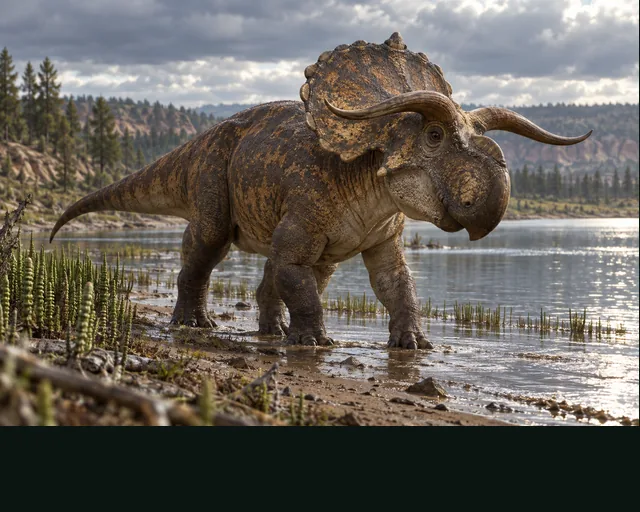
This matters when looking at a finished restoration. A whole body can be illustrated even when the scientific description concerns only parts of a head. The image must therefore be labelled as a reconstruction rather than presented as a record of every bone recovered.
Why are frills informative?
Ceratopsian skulls contain many features that can be compared between taxa. Their frills are more than decorative outlines: the form and arrangement of preserved bones can help distinguish one animal from another.
However, a conspicuous horn in a picture is not automatically the feature that established the name. Some parts of a complete head require artistic completion. Readers should ask which region is actually preserved and which details belong to a restoration before treating the entire profile as equally certain.
How does Arizona expand the picture?
North America’s horned dinosaurs are known from many localities, but collecting has not sampled every region equally. An Arizona discovery helps researchers test whether communities farther south differed from better-known northern assemblages.
The presence of related animals in different regions does not by itself establish a migration route or a direct ancestor. Their ages, anatomy and geological settings must be compared. Crittendenceratops adds a named record to that broader investigation without settling every question about ceratopsian distribution.
Reading our portrait
The illustration follows a complete reference specifically identified as Crittendenceratops. Its forward-projecting brow ornament, short broad frill, four-legged body and full tail are retained as the reference artist’s interpretation. The completed horns, mature proportions and spotted colours are not claimed as an intact fossil animal.
The stance also cannot establish whether it lived in herds or used its head in a particular contest. The portrait makes the animal approachable; the source record explains how much of its history can actually be tested.
Compare Nasutoceratops and Centrosaurus, then explore the C directory.
Quick answers
- Where was Crittendenceratops discovered?
- In the Fort Crittenden Formation of southeastern Arizona.
- How complete are the naming fossils?
- The study used partial skull material from two individuals, not a complete body.
- What group did the study recover?
- Nasutoceratopsini, within the centrosaurine horned dinosaurs.
- Are all horns in the picture directly preserved?
- The complete head and horn arrangement contain artistic completion and are not claimed as an intact fossil skull.