Jurassic Dinos editorial · Updated · Source-based review
What was Comptonatus?
Comptonatus was a plant-eating iguanodontian dinosaur from the Isle of Wight in southern England. Its species, Comptonatus chasei, was named in 2024. The fossils come from the Early Cretaceous Wessex Formation.
Its discovery joins a growing picture of diversity among the island’s plant-eating dinosaurs. An iguanodontian is not automatically Iguanodon, just as every large cat is not a lion. Researchers must test the details rather than relying on an animal’s general silhouette.
Who discovered it?
Fossil collector Nick Chase spotted the specimen at Compton Bay in 2013. The species name honours his contribution. After excavation and study, the fossil became part of the Dinosaur Isle Museum collections, where it remains available as evidence for future research.
The naming study examined 149 bones. That unusually informative collection allowed many regions of the skeleton to be compared. Completeness is helpful because it supplies more potential characters, but even an impressive fossil is not a preserved record of every aspect of an animal’s life.
Why was it not Mantellisaurus?
The specimen was initially considered an example of Mantellisaurus. Detailed work led by Jeremy Lockwood identified a combination of differences supporting a separate genus. Museum explanations highlight features involving the skull, teeth and shoulders.
This is how a new dinosaur can emerge from close examination rather than a single spectacular horn or claw. Many identifying characters are subtle. Researchers compare equivalent structures in other specimens and ask whether the differences are consistent, informative and more than ordinary variation.
Did several similar dinosaurs live together?
Comptonatus adds another iguanodontian to the island’s fossil record. However, several animals found in one region need not have occupied it at exactly the same moment. Rock layers can represent substantial intervals of time.
The museum discussion identifies an open question: did related forms replace one another relatively quickly, or did several coexist? Answering it requires better fossils and careful geological comparison. A landscape illustration should not quietly resolve that question by putting every named animal into one imagined herd.
Reading the whole-animal portrait
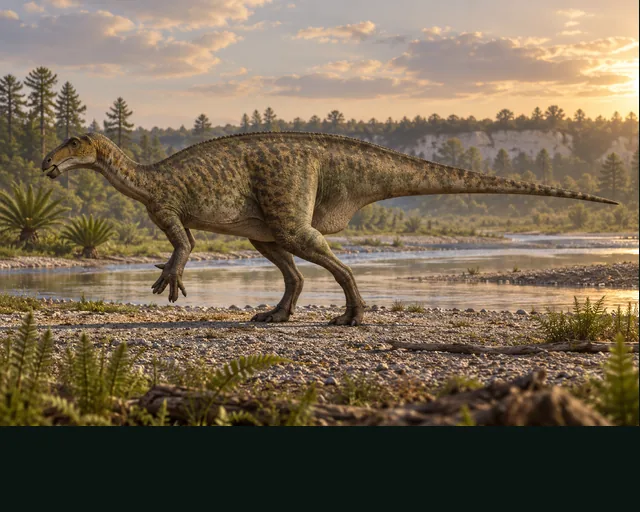
Our image follows a complete reference specifically labelled Comptonatus chasei. It retains the low beaked head, deep torso, four-legged stance and long tail. The spotted colours, soft tissues and setting are artistic interpretations, not a direct record of a particular individual.
Likewise, the image cannot prove an exact body mass, social group or daily behaviour. The value of the fossil lies in the anatomical comparisons that distinguish it, together with the collection and publication records that make those comparisons testable.
Compare Mantellisaurus and Iguanodon, then browse the C directory.
Quick answers
- Who found Comptonatus?
- Nick Chase found the specimen at Compton Bay in 2013.
- Why is its species called chasei?
- The name honours the fossil finder Nick Chase.
- Was it originally identified differently?
- It was initially thought to be Mantellisaurus before detailed study supported a new genus.
- Does a detailed skeleton prove herd behaviour?
- No. A proposed life reconstruction still requires evidence beyond the appearance of one skeleton.