Jurassic Dinos editorial · Updated · Source-based review
What was Coahuilaceratops?
Coahuilaceratops was a horned dinosaur from Late Cretaceous northern Mexico. Its name links it to the state of Coahuila. Large brow horns are among its most striking features, but the fossils preserve an incomplete animal rather than a fully measurable, intact skeleton.
What makes the fossil distinctive?
The skull material supports a chasmosaurine ceratopsid: a plant eater with a beak, frill and facial horns. Horn fragments can indicate impressive size, but reconstructing their complete length adds uncertainty. Record-breaking claims should distinguish the surviving bone from the restored outline.
Where was it found and how was it named?
The fossils were discovered in 2001, excavated in 2003 and named in 2010. Adult and younger material contributed to the description. More recent work revised the rock assignment from the Cerro del Pueblo Formation to the overlying Cerro Huerta Formation, placing the relevant deposits in the early Maastrichtian.
What can we infer, and what remains uncertain?
This revision matters when comparing Coahuilaceratops with dinosaurs elsewhere in North America. Two similar animals may not have lived at the same time. Rock layers provide the time framework, while skull characters provide the anatomical comparison. Neither a map alone nor a horn silhouette can establish whether populations met or competed.
Why can its geological age change after naming?
Researchers can revise the boundaries and dates of the rock layers containing the fossils without changing the identity of the preserved bones.
How can you check the evidence?
The Paleobiology Database record catalogues Coahuilaceratops under Chasmosaurinae. Its linked bibliography identifies this research starting point: M. A. Loewen, S. D. Sampson, and E. K. Lund, A. A. Farke, M. C. Aguillón-Martínez, C. A. de Leon, R. A. Rodríguez-de la Rosa, M. A. Getty, D. A. Eberth. 2010. Horned dinosaurs (Ornithischia: Ceratopsia) from the Upper Cretaceous (Campanian) Cerro del Pueblo Formation, Coahuila, Mexico. New Perspectives on Horned Dinosaurs: The Royal Tyrrell Museum Ceratopsian Symposium. Indiana University Press, Bloomington. Open the bibliographic record. A catalogue entry establishes the source trail; it does not independently verify every later illustration or behavioural claim.
Use the dated genus overview to follow the references behind the discovery and anatomy discussed above. When sources disagree, compare which specimen and rock layer each author studied. A reconstructed whole animal can combine original bones with comparisons to relatives; those two kinds of evidence should not be confused. The account above explains the particular limits that matter for Coahuilaceratops, rather than supplying unsupported size, speed or lifespan figures.
Read the image and keep exploring
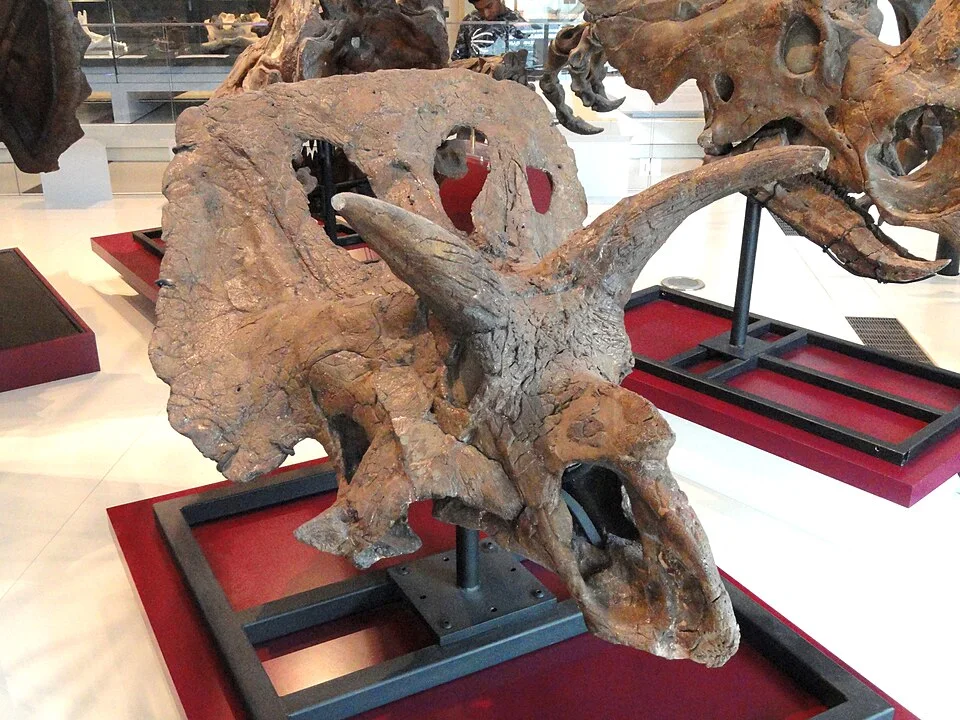
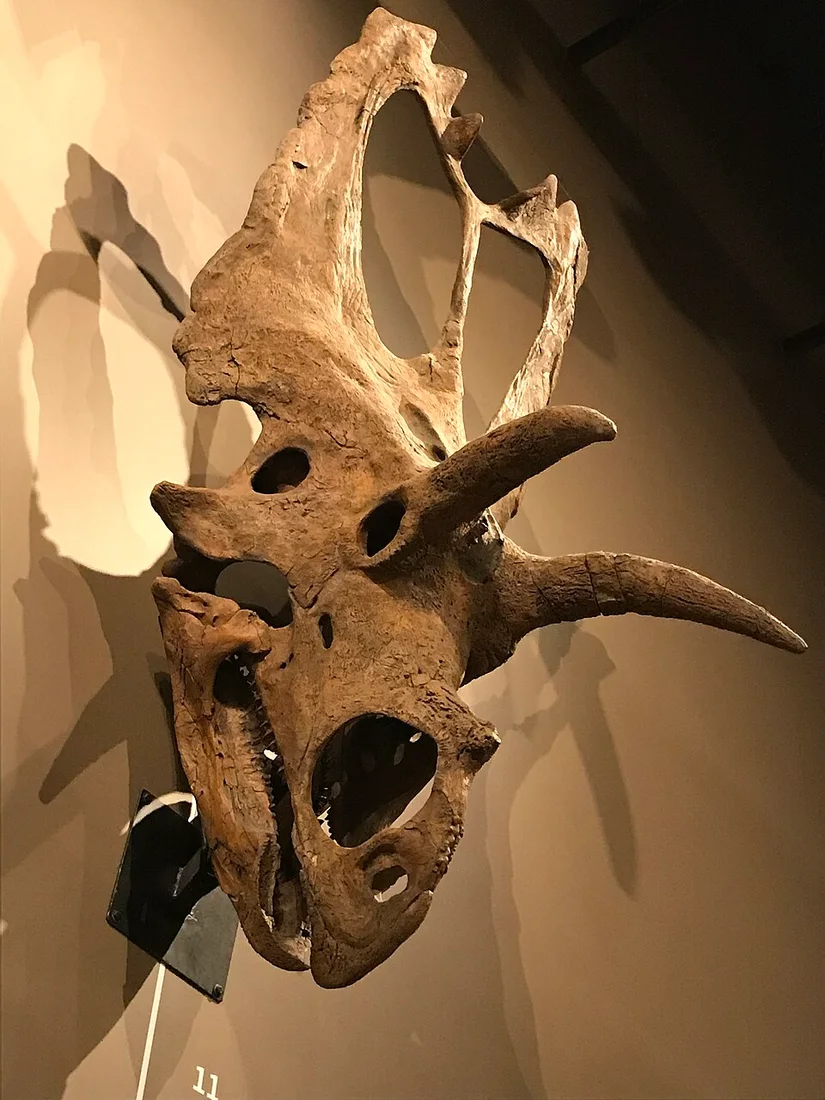
The Coahuilaceratops skull display illustrates the large brow horns and frill; reconstructed portions complete its appearance. A displayed specimen or skeletal mount can include restored parts. Its appearance should be read alongside the original specimen description.
Compare Triceratops, Arrhinoceratops, Chasmosaurus. Find more names in the C index and explore ornithischian field notes. The glossary explains unfamiliar fossil terms.
Quick answers
- Where have Coahuilaceratops fossils been found?
- The discoveries discussed here come from Mexico. Modern place names describe discovery locations, not a complete ancient geographic range.
- When did Coahuilaceratops live?
- It is placed in the Cretaceous period. See the discovery discussion for qualifications about the particular rock layers and dating.
- Where can I compare Coahuilaceratops with related dinosaurs?
- Follow the related field notes below. Comparisons explain shared anatomy; they do not imply that all the animals lived together.