Jurassic Dinos editorial · Updated · Source-based review
What was Chubutisaurus?
Chubutisaurus was a large plant-eating sauropod from Patagonia in southern Argentina. Its species is Chubutisaurus insignis. The name connects it with Chubut, the province where its fossils were found.
Like other sauropods, it had a long-necked, four-legged body plan. However, being able to recognise a general sauropod outline is different from knowing every detail of this particular animal. Much of the scientific work concerns its preserved postcranial skeleton: the bones behind the head.
Why revisit an old fossil site?
A 2011 anatomical study described additional material recovered from the original quarry. The researchers interpreted the new remains as belonging to the same individual as the type specimen. Returning to the field therefore helped extend an older discovery rather than merely adding a disconnected museum object.
That interpretation still depends on the geological and anatomical evidence. Finding bones in one quarry is not automatically enough to prove that every fragment belongs to one animal. Researchers must examine their positions, duplication and compatibility before drawing that conclusion.
How did the new material help?
The extra bones allowed the diagnosis to be expanded. A diagnosis describes the features that distinguish a taxon from its relatives. Adding well-identified anatomy can make an existing name easier to recognise and can improve the information available for an evolutionary analysis.
The reviewed study placed Chubutisaurus among early-branching somphospondylans. Somphospondylans are a large sauropod branch that includes titanosaurs as well as animals outside that narrower group. We therefore avoid treating every broad long-necked dinosaur label as interchangeable.
When did it live?
The fossil-bearing rocks belong to the Cretaceous Cerro Barcino Formation. The original review discussed an age around the Aptian–Cenomanian interval. Because that range crosses the familiar Early and Late Cretaceous boundary, this page uses the broad period rather than assigning a false precision to the animal.
Formation ages are geological interpretations that can be improved by further dating. A dinosaur fossil does not come with a calendar label, and a date for one rock layer must not be transferred to another without checking their relationship.
What does the picture add?
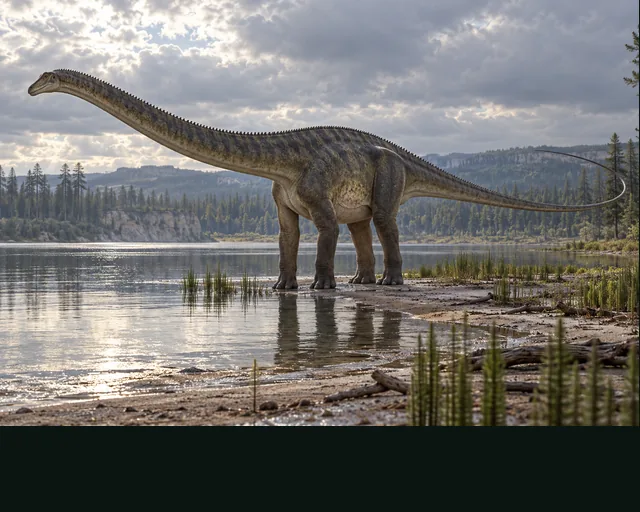
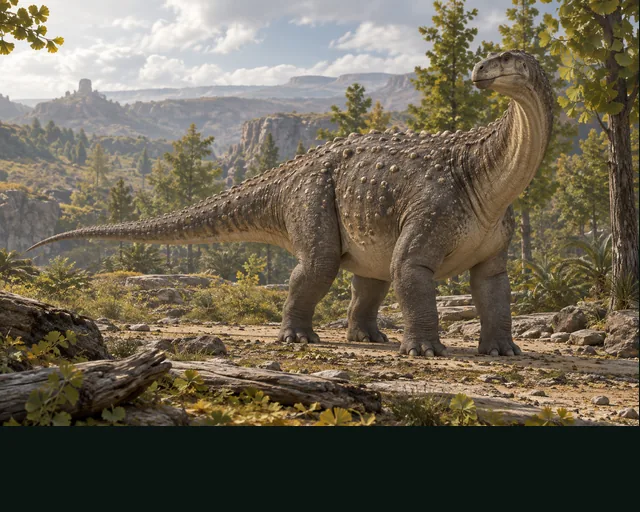
Our illustration follows a named complete restoration, including its long neck and unusually high-curled tail. That tail pose, surface ornament and skin colours remain artistic interpretations. They are not evidence that Chubutisaurus habitually held its tail in a loop or that a complete armoured body was found. The portrait provides a visual introduction while the source record explains the actual discovery.
Compare Saltasaurus and Diplodocus, then browse the C directory.
Quick answers
- Where was Chubutisaurus found?
- In Chubut, Patagonia, Argentina.
- Why return to its original quarry?
- Additional bones can clarify anatomy and improve the features used to identify the animal.
- Was it certainly a titanosaur?
- The reviewed anatomical study placed it as an early-branching somphospondylan, so a narrow titanosaur label is not treated as settled here.
- Is the curled tail a fossil observation?
- No. It follows a historical complete restoration and does not establish habitual posture.