Jurassic Dinos editorial · Updated · Source-based review
What was Chuanjiesaurus?
Chuanjiesaurus was a plant-eating sauropod from Middle Jurassic China. Its species is Chuanjiesaurus anaensis. The fossils come from the Chuanjie Formation in Yunnan, adding to the record of long-necked dinosaurs in eastern Asia.
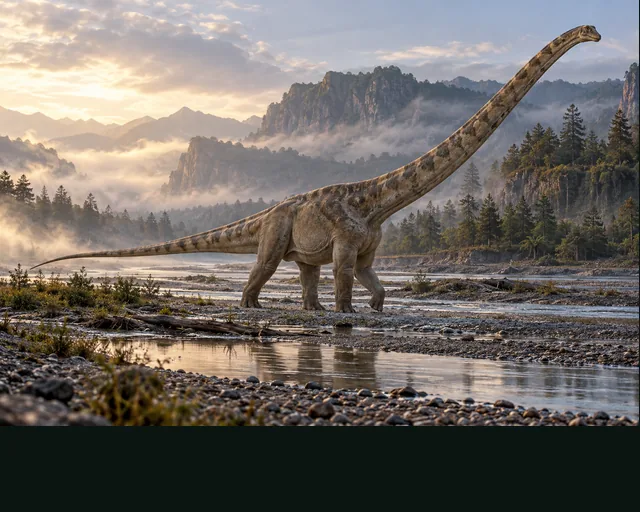
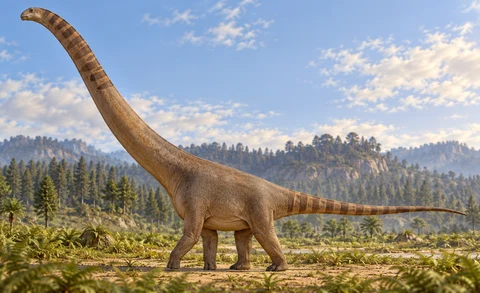
The approved complete reference shows a small head carried on a very long neck, a deep body and a tapering tail. That outline introduces the animal, but understanding its history also requires keeping track of which fossil specimens belong to the name.
Why was it re-examined?
The genus was named in 2000. A detailed 2011 study revisited its anatomy and diagnosis. A diagnosis is the combination of features used to distinguish a named animal from other known animals; it is more precise than a general description such as large and long-necked.
That study compared both the type material and a skeleton then referred to Chuanjiesaurus. Its evolutionary analysis associated the animal with mamenchisaurids. As with any analysis, the result depends on the specimens and character identifications included.
Where does Analong fit?
Later research separated the referred specimen LFGT LCD 9701-1 as Analong. This did not make the Chuanjiesaurus naming specimen disappear. It changed the interpretation of a different skeleton that had previously been assigned to the genus.
That distinction is easy to lose when descriptions are copied between websites. A paragraph written before a revision may combine information that later research keeps separate. Here, the Chuanjiesaurus account does not silently import every feature of the now-separated Analong material.
What does a revision teach us?
Scientific names are attached to physical evidence, not just attractive illustrations. A type specimen provides a stable reference, while additional assignments can be reconsidered. Comparing collection numbers and publication dates helps readers understand how an account changes without assuming that all earlier work was useless.
The same care applies to body estimates. A long-necked restoration is not a direct measurement of a complete living animal. Missing elements, posture and the identity of referred material can all affect an estimate.
Reading our reconstruction
The picture follows a complete reference explicitly identified as Chuanjiesaurus anaensis. Its side-oriented stance keeps the overlapping far-side limbs readable without inventing an entirely different view. The colour pattern, soft tissue and surrounding vegetation remain artistic choices.
A raised neck does not establish its usual feeding height or prove that it spent every day browsing high branches. The image offers an inviting whole-animal view while the text preserves the separate identities and uncertainties that make the fossils scientifically useful.
Compare Analong and Mamenchisaurus, then visit the C directory.
Quick answers
- Where was Chuanjiesaurus found?
- Its fossils come from the Chuanjie Formation of Yunnan, China.
- Was it a plant-eater?
- It was a sauropod, interpreted as herbivorous.
- Is Analong another name for the same specimen?
- Analong was established for material formerly referred to Chuanjiesaurus, rather than replacing the Chuanjiesaurus type.
- Does a very long neck give an exact feeding height?
- No. A restored pose does not establish the full range or usual position of a living neck.