Jurassic Dinos editorial · Updated · Source-based review
What was Chuandongocoelurus?
Chuandongocoelurus was a theropod dinosaur from Jurassic China. Its fossils were described by He in 1984 in a study of Sichuan vertebrates. The animal belongs to the wider investigation of how early branches of large predatory dinosaur groups were related.
Its name is less familiar than Allosaurus, but an obscure dinosaur can still be scientifically useful. A bone does not have to belong to a famous animal to preserve a character that changes an evolutionary analysis.
Why does the naming specimen matter?
A scientific name is anchored to particular type material. Other fossils may later be referred to that animal because they appear similar. Referred material, however, is an interpretation that should be tested, rather than a guarantee that every bone represents the same species.
For Chuandongocoelurus, it is especially important not to combine the smaller naming material and a larger, tentatively associated individual into one confident complete skeleton. Differences could reflect age, different animals or a mistaken assignment. Sorting those possibilities requires anatomical evidence, not merely a shared location or a convenient size match.
What does Tetanurae mean?
Tetanurae is a large branch of the theropod family tree. Researchers investigate its early history by comparing combinations of features in the pelvis, vertebrae, limbs and skull wherever those regions are preserved.
A 2010 study discussed Chuandongocoelurus alongside Monolophosaurus. Their mixture of relatively primitive and more derived traits was relevant to the early branches of that group. Primitive here means an older evolutionary character state, not an animal that was poorly designed for its own life.
Comparing two genera does not make them the same animal. Nor does an uncertain position mean that scientists know nothing. It means that some questions can be answered from the available anatomy while a more precise branching order remains open to revision.
What can a complete illustration show?
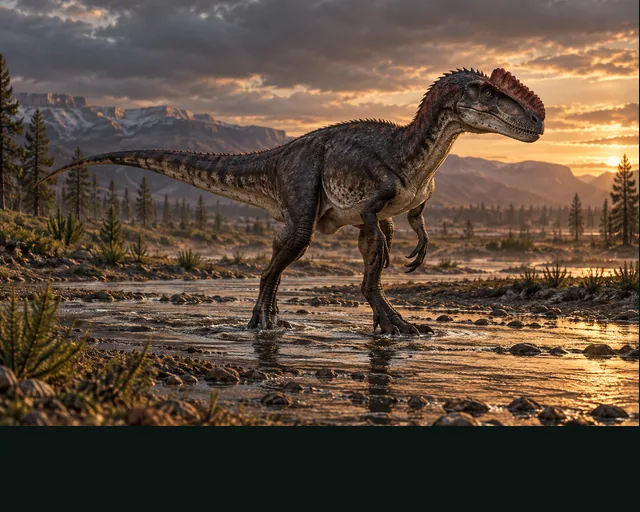
Our image follows a full-body restoration specifically labelled Chuandongocoelurus. The low head, grasping forelimbs, powerful hindlimbs and rising tail provide its visual framework. We do not ask an image generator to invent an entire animal from a fossil photograph.
Nevertheless, that reference is itself a reconstruction. Its completed skull shape, soft tissues, colours and skin detail contain interpretation. The scene cannot establish that the animal hunted in this particular way or occupied this exact patch of landscape. Reading the picture alongside its limitations helps keep an engaging dinosaur portrait separate from the surviving scientific evidence.
Compare Monolophosaurus and Allosaurus, then browse the C directory.
Quick answers
- Where did Chuandongocoelurus come from?
- Its fossils are from Jurassic rocks in Sichuan, China.
- Why not combine all referred bones?
- Material assigned tentatively to a genus need not belong to the same species or individual as the naming specimen.
- Was it Monolophosaurus?
- No. Anatomical comparison does not by itself erase a separate genus name.
- Is the restored skull completely known?
- The full image contains interpretive completion and should not be treated as a complete fossil skeleton.