Jurassic Dinos editorial · Updated · Source-based review
What was Chadititan?
Chadititan was a plant-eating titanosaur from northern Patagonia. Its species is Chadititan calvoi. Compared with the enormous sauropods that often dominate dinosaur headlines, the researchers described it as relatively small and slender. Titanosauria contained a variety of body forms, so belonging to that group did not require an animal to be among the biggest dinosaurs.
Where did its fossils come from?
The discovery comes from the Anacleto Formation near General Roca in Río Negro, Argentina. These are Late Cretaceous rocks. The reported meaning of the name is titan of the salt, recalling the extensive salt-flat landscape near the discovery area.
Its modern location should not be confused with an exact picture of the ancient landscape. Researchers use the rocks and the whole fossil collection to investigate what the area was like when the animals were alive.
What made it distinctive?
The research announcement highlights elongated vertebrae and delicate limb bones. Vertebrae are the individual bones of the backbone. Such proportions help scientists compare Chadititan with other titanosaurs, including the rinconsaurian group to which the study assigned it.
Slender bones do not automatically mean that a dinosaur ran at a particular speed or behaved timidly. A structural description becomes a claim about movement or behaviour only after further evidence and analysis. We avoid turning the appealing phrase gentle giant into a scientific diagnosis of personality.
Why study the other fossils too?
The locality yielded much more than a new dinosaur. The reported collection includes freshwater turtles, fishes, molluscs and other vertebrates. Researchers used those finds together with the sediments to investigate an ancient environment, including water within a wider dry landscape.
An assemblage is the collection of remains being studied. It can reveal an ecosystem more fully than one spectacular bone. However, it is not necessarily a single frozen moment in which every animal stood beside the same pond. Burial and preservation can combine evidence from different events.
What does the illustration add?
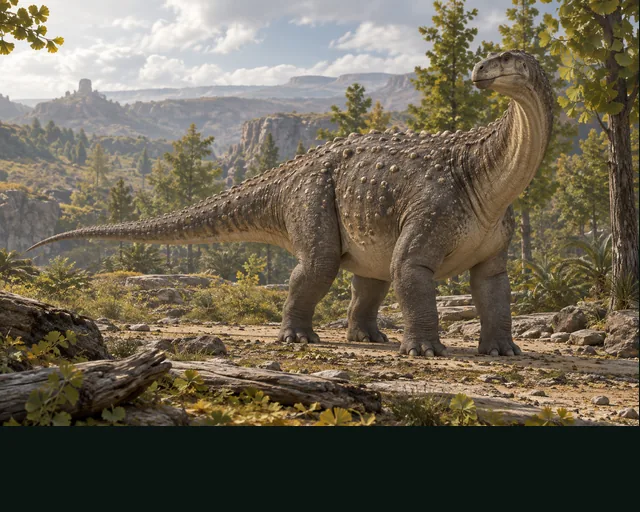
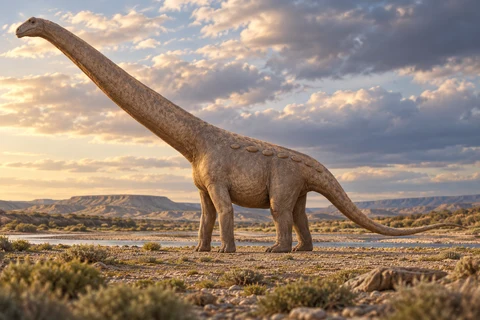
Our image follows Connor Ashbridge’s complete, explicitly named Chadititan restoration. Its long raised neck, small head, relatively gracile trunk, four limbs and tapering tail provide the visible anatomical reference. The patterned skin, colours and complete external proportions remain artistic choices.
The picture does not show a complete skeleton being discovered, and its size cannot be measured against a real landscape feature. It is an invitation to explore the animal alongside the evidence, not a substitute for that evidence.
Compare Saltasaurus and Aeolosaurus, then browse the C directory.
Quick answers
- Was Chadititan one of the largest titanosaurs?
- No. The researchers described it as relatively small and slender within that diverse group.
- Where did it live?
- Its fossils come from the Anacleto Formation of Río Negro in northern Patagonia, Argentina.
- What does its name refer to?
- The reported meaning is titan of the salt, recalling the salt-flat setting near the discovery.
- Does the fossil collection show one exact moment?
- A mixed assemblage helps reconstruct an ecosystem, but individual remains may have different burial histories.