Jurassic Dinos editorial · Updated · Source-based review
One genus, more than one naming story
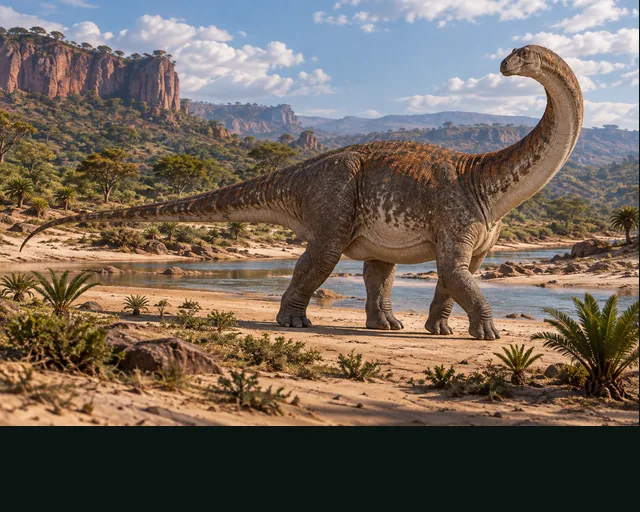
Aeolosaurus was a titanosaurian sauropod from the Late Cretaceous of Argentina. It belonged to the long-necked dinosaur branch whose members walked on four legs and ate plants. This page introduces the genus, while the illustration specifically follows a restoration labelled Aeolosaurus rionegrinus.
A genus is a scientific grouping that can contain more than one species. Keeping both parts of a species name matters here, because not every fossil once called Aeolosaurus still belongs to the same genus.
What can a tail reveal?
In 2007, Gabriel Casal and colleagues described Aeolosaurus colhuehuapensis from an articulated series of tail vertebrae found at Lago Colhué Huapi in Chubut, Argentina. Articulated means that the bones retained their connections or original sequence, rather than appearing as an unordered collection.
A connected sequence is valuable because vertebrae change shape along a tail. Knowing the order helps researchers compare corresponding regions. Comparing a bone near one animal’s hips with a bone near another animal’s tail tip could otherwise produce a misleading impression of difference.
The tail series does not provide a complete head-to-tail body outline. It supports anatomical comparisons while leaving other parts less directly documented.
Why does Arrudatitan appear in older searches?
A Brazilian sauropod was originally named Aeolosaurus maximus. A reassessment published online in 2021 moved it into a separate genus, Arrudatitan. The study distinguished that Brazilian material from the Argentine Aeolosaurus species.
This was a change in scientific classification, not the discovery that the fossil had disappeared. Older books and webpages may retain the earlier combination. When reading a size estimate or looking at an illustration, check which species and specimen the author actually means. A number attached to A. maximus should not silently become a measurement for A. rionegrinus.
How large was Aeolosaurus, and what did it eat?
Its sauropod relationships support a plant-eating diet. We do not give one precise length or mass for the whole genus: different species and incomplete specimens require separate estimates. The same caution applies to a favourite plant or a particular feeding height, neither of which is established by the sources reviewed here.
What is interpretive in our artwork?
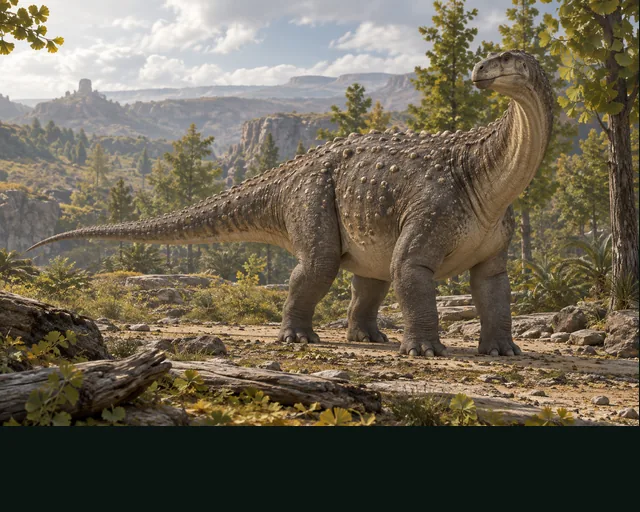
Our image follows Ornithopsis’s complete Aeolosaurus rionegrinus restoration. The source artist explicitly reconstructed the head and neck using comparisons with another titanosaur. We did not use that relative’s image as a replacement reference. The head, soft tissues, rounded back ornaments and colour remain features of the named artwork, not a claim that a complete Aeolosaurus body was found.
Explore Rapetosaurus, Saltasaurus, or the A–Z directory under A.
Quick answers
- Where did Aeolosaurus live?
- This account covers the Late Cretaceous Argentine species of Aeolosaurus.
- Is Arrudatitan the same name?
- A Brazilian species once called Aeolosaurus maximus was reassigned to Arrudatitan in a study published online in 2021.
- Why are connected tail bones useful?
- Their order helps researchers compare equivalent parts of the tail rather than mismatching vertebrae from different positions.
- Which species does the picture represent?
- The credited complete reference is labelled Aeolosaurus rionegrinus; the reconstructed head and other missing details remain interpretive.