Jurassic Dinos editorial · Updated · Source-based review
What was Cetiosauriscus?
Cetiosauriscus was a plant-eating sauropod from Jurassic England. The species used in this account is Cetiosauriscus stewarti. Like other sauropods, it belongs to the dinosaur story of long necks, four weight-bearing limbs and substantial tails. Its name may sound similar to Cetiosaurus, but similar names should not be treated as proof that two entries describe the same animal.
The Natural History Museum places Cetiosauriscus in the Middle Jurassic and records England as its fossil location. We keep that broad, supported setting rather than presenting an unchecked exact date for an individual animal.
Why does its name matter?
The genus is attributed to Friedrich von Huene in 1927. Later work used the species name stewarti. In 1993, Alan Charig published a formal proposal concerning its designation as the genus’s type species; the museum directory now lists stewarti in that role.
A type species provides a reference for the meaning of a genus name. Without that connection, different researchers might use the same genus label for different sets of fossils. Nomenclature is the system of rules that helps keep those labels understandable.
Is naming the same as discovering a relationship?
No. Deciding how a name is anchored and deciding where an animal fits in an evolutionary tree are related but different tasks. A stable name helps researchers discuss a fossil even while its precise relationships are being investigated.
For Cetiosauriscus, we use the broad sauropod identity rather than presenting one narrow family assignment as the final answer. A dinosaur’s appearance in a list or a historical illustration is not, by itself, a new anatomical analysis.
How large was the living animal?
Museum directories may give useful size estimates, but an estimate is not a measurement of a complete living dinosaur. A reader should ask which bones support a reconstruction and which parts are missing before treating a body length as exact.
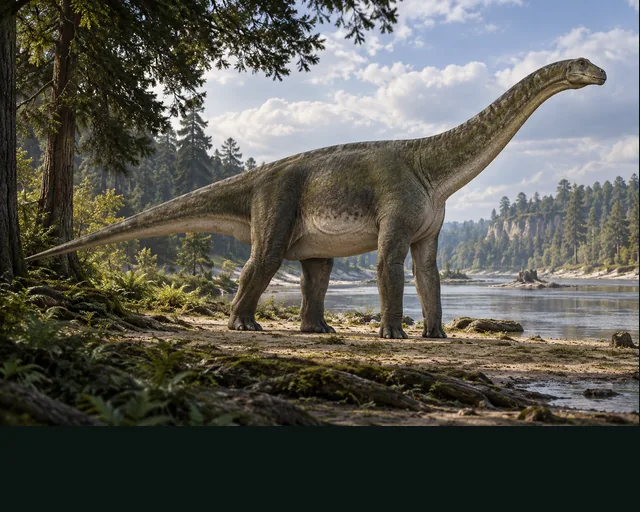
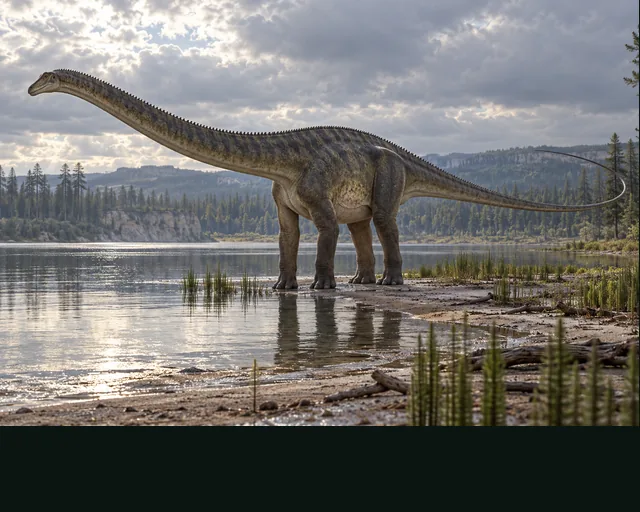
Our comparison fields therefore do not turn the artwork into a ruler. The image is intended to explain a body plan, not settle an adult mass or demonstrate a particular feeding height.
What is historical in the restoration?
The inspected museum reference depicts a complete animal with a rising neck and low curled tail. Our image retains that named restoration while marking the pose and missing external anatomy as interpretive. It does not claim that a curled tail proves habitual dragging, or that every skin detail is preserved.
Compare Cetiosaurus and Diplodocus, then visit the C directory.
Quick answers
- Was Cetiosauriscus a whale?
- No. It was a sauropod dinosaur; a historical name meaning is not a biological classification.
- Where and when did it live?
- The museum directory places it in Middle Jurassic England.
- Which species is used here?
- Cetiosauriscus stewarti, the type species listed by the Natural History Museum.
- Does the low tail in the picture show habitual tail dragging?
- No. The image follows a historical complete restoration, and that pose is not proof of everyday movement.