Jurassic Dinos editorial · Updated · Source-based review
What was Cariocecus?
Cariocecus was a plant-eating ornithopod from Early Cretaceous Portugal. Its species is Cariocecus bocagei, named in 2025. It belonged to the hadrosauroid branch, rather than to the long-necked sauropods. The skull is the star of its story: it preserves features that allowed researchers to recognise an unusual animal and investigate details hidden inside the rock.
Where did the discovery happen?
The partial skull was discovered in 2016 at Praia do Areia do Mastro, near Cabo Espichel in the Sesimbra area. Its rocks belong to the Papo Seco Formation. Preparing and studying a fragile fossil takes time, which helps explain why discovery and formal naming happened years apart.
A coastal exposure today is not a complete description of the ancient animal’s habitat. Geologists study the rocks and associated remains to interpret the environment, while palaeontologists investigate which animal the skull represents.
What was unusual about its face?
The researchers highlighted fusion between the maxilla, a main upper-jaw bone, and the jugal, a cheek bone. A low structure above the eye was also distinctive. These are anatomical observations. Suggestions about stronger biting or the function of a heavy brow go a step further and should be recognised as interpretations.
The known individual was not fully mature, according to features of its skull joints. Its skull therefore should not be used to announce a perfectly known adult body size or proportions.
How did scientists look inside?
Micro-CT scanning uses X-rays to create many thin views through an object, which can be combined into a digital model. In this study it helped investigate cranial passages, the inner-ear region and replacement teeth within the jaw.
These are views of fossilised structures and spaces, not a scan of a living dinosaur brain. The method is valuable because it can reveal information that would be difficult to expose mechanically without damaging the specimen. Observations still need careful anatomical interpretation.
What is the difference between the skull and the artwork?
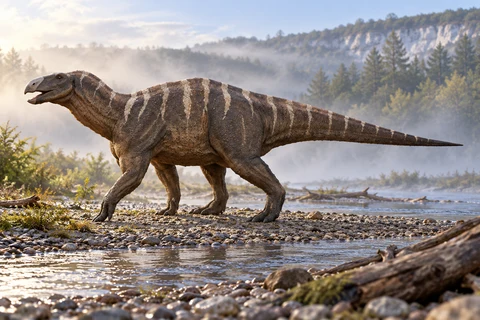
Our complete-body image follows Connor Ashbridge’s explicitly named Cariocecus restoration. It retains the low beaked head, broad neck, deep trunk, limbs and tapering tail. The restored body contour, colours and skin pattern are artistic rather than a newly discovered complete skeleton.
The illustration does not borrow cutaneous spikes from another dinosaur merely because a bibliography mentions them. Keeping each claim tied to the correct animal matters as much as making the picture attractive.
Read about Iguanodon and Brighstoneus, then explore the C directory.
Quick answers
- Was Cariocecus a sauropod?
- No. It was a hadrosauroid ornithopod, on the wider branch that includes duck-billed dinosaurs.
- What is unusual about its face?
- The upper-jaw maxilla and cheek bone were fused, and a low brow structure was also notable.
- Did researchers scan its actual brain?
- They studied the fossil skull and internal spaces/impressions with micro-CT; this is not a preserved living brain.
- Was it definitely a powerful tough-plant specialist?
- A stronger bite is an interpretation suggested by the skull, not a directly measured feeding event.