Jurassic Dinos editorial · Updated · Source-based review
What was Brighstoneus?
Brighstoneus was a beaked, plant-eating ornithopod from Early Cretaceous England. Its species is Brighstoneus simmondsi. Researchers described it as a hadrosauriform outside Hadrosauridae: part of a wider branch related to the later duck-billed dinosaurs, rather than simply another specialised duckbill.
Those long group names describe relationships. They do not mean that every member looked alike or that an earlier animal must have been the direct ancestor of a later one. Brighstoneus is valuable because it adds another distinctive animal to that branching history.
Where did the discovery come from?
The fossils came from the Wessex Formation on the Isle of Wight. Jeremy Lockwood, David Martill and Susannah Maidment formally described the species in 2021. The genus recalls Brighstone, and the species name honours Keith Simmonds.
The island is famous for dinosaur fossils, including several large beaked plant-eaters. Finding bones there does not automatically make them Iguanodon. The task is to compare the actual features of each specimen with the features used to identify already named animals.
Why was a new name needed?
The authors recognised a distinctive combination of skull and body characteristics. Their comparisons included Iguanodon and Mantellisaurus, two familiar names from the region’s broader dinosaur story. The head and nasal region contributed to the assessment, but identification did not rest on a catchy nickname about a large nose.
A scientific diagnosis is like a carefully checked list of distinguishing clues. It should work on fossil anatomy, even if two illustrators give their reconstructions completely different colours. A pattern of stripes cannot establish which species a bone belongs to.
Can museum collections still produce discoveries?
Yes. Studying stored material and comparing it systematically can reveal differences that were missed or grouped together in earlier work. A discovery does not always begin with a dramatic new skeleton sticking out of a cliff.
This makes cataloguing, preparation and patient measurement part of the adventure. The age of a fossil’s discovery and the year when its animal receives a scientific name may be far apart.
What should you notice in the restoration?
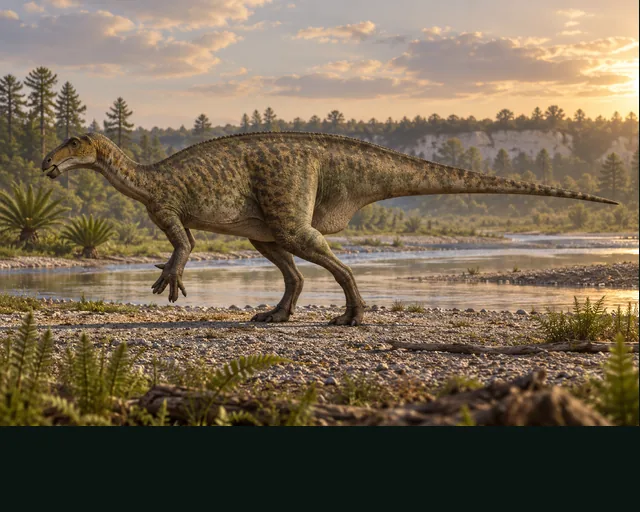
Our image follows the credited complete Brighstoneus artwork, retaining a broad beaked head, robust four-legged body and long deep tail. The striped skin, rounded back contour and exact pose remain artistic interpretations. We do not turn them into claims about display behaviour or a measured adult size.
Explore Iguanodon and Mantellisaurus, then return to the B directory.
Quick answers
- Where did Brighstoneus live?
- Its fossils come from the Early Cretaceous Wessex Formation of the Isle of Wight, England.
- Was it another Iguanodon?
- The 2021 study identified a distinct combination of anatomical features and named a separate genus and species.
- What does simmondsi mean?
- It honours Keith Simmonds, associated with discovering the specimen.
- Was it a specialised duck-billed hadrosaurid?
- The original description places it outside Hadrosauridae, among earlier-branching hadrosauriform relatives.