Jurassic Dinos editorial · Updated · Source-based review
What was Bravasaurus?
Bravasaurus was a long-necked sauropod from Late Cretaceous Argentina. Its species is Bravasaurus arreirosorum. Although titanosaurs are famous for including some enormous dinosaurs, Bravasaurus shows that the group also contained smaller animals. The word titanosaur is a statement about relationships, not a promise that every member was a record-breaking giant.
Where was it found?
The original study describes fossils from the Ciénaga del Río Huaco Formation in La Rioja, northwestern Argentina. Published in 2020, the research also introduced another sauropod, Punatitan. These were separate animals with their own anatomical evidence.
When one paper names more than one dinosaur, it is easy for a quick summary to mix their details. A measurement, locality note or diagnostic feature should stay attached to the specimen it describes. We therefore avoid combining the larger Punatitan’s body with Bravasaurus’s name.
Could the smaller animal simply have been young?
That is an important question whenever a small dinosaur is discovered. The authors combined observations of the bones with body-size analysis and considered Bravasaurus probably close to its maximum size. This supports a genuinely smaller titanosaur rather than an automatic baby-giant explanation.
It does not mean we can state a perfectly precise adult weight. Estimating a missing living body requires assumptions, and different methods can produce different results. A relative statement, such as smaller than another named animal in the study, can be more defensible than a single impressive number.
What about the eggs from the formation?
The researchers also described egg-bearing levels in the region. A clutch is a group of eggs laid together. Such sites help scientists investigate reproduction and repeated use of a landscape.
However, eggs from a formation are not automatically eggs of whichever dinosaur is best known from that formation. A direct identification might need an embryo or other strong association. Our account does not turn nearby clutches into confirmed Bravasaurus nests.
What is reconstructed in the image?
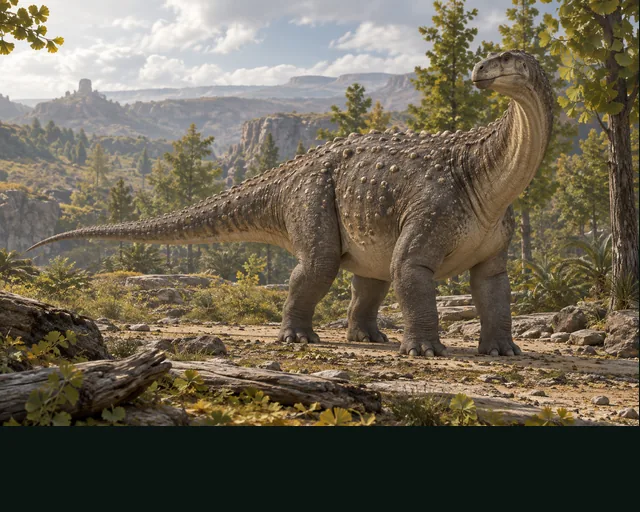
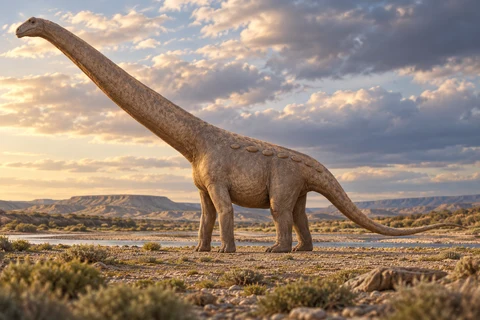
The approved full-body reference gives our illustration its small head, rising neck, deep trunk and tapering tail. The reference’s scutes, skin colours and completed body proportions are artistic interpretations. The new scene provides atmosphere while avoiding a made-up nest or a factual claim about a particular group of animals.
Compare Saltasaurus and Aeolosaurus, or visit the B directory.
Quick answers
- Was Bravasaurus a giant?
- It was a titanosaur, but the original study described it as small compared with many other titanosaurs.
- Was Bravasaurus the same as Punatitan?
- No. The same research paper described two separately identified dinosaurs.
- Was the specimen just a baby giant?
- The authors considered anatomical evidence suggesting that the known Bravasaurus was probably close to its maximum size.
- Do the nearby eggs definitely belong to Bravasaurus?
- Not simply because eggs and this dinosaur occur in the same formation. A direct identification needs additional evidence.