Jurassic Dinos editorial · Updated · Source-based review
What was Borealosaurus?
Borealosaurus was a sauropod dinosaur from China. Its species, Borealosaurus wimani, was named in 2004. It belongs in the story of Cretaceous Asian long-necked dinosaurs, but its fossil record is much less complete than the living animal in an illustration might suggest. The preserved clues are useful precisely because researchers can compare their details with other fossils.
Why is its tail important?
The name-bearing material includes a middle tail vertebra. Vertebrae are the repeated bones making up the backbone; their joint surfaces, ridges and openings can differ between dinosaur groups. A tail bone can therefore tell a specialist more about identity than a dramatic painting of a whole animal.
A 2013 comparison considered similarities between Borealosaurus and other Asian sauropods, including Opisthocoelicaudia. It cautioned that superficially similar joint shapes occurred in different positions or to different degrees. One shared feature is not enough, by itself, to establish the closest relationship.
Can scattered bones be combined safely?
An upper-arm bone had also been referred to Borealosaurus. The same study explained that its association could not be substantiated and that its proportions appeared inconsistent with belonging to the individual represented by the type tail vertebra.
Think of finding puzzle pieces in more than one box. Similar colour is not proof that they fit the same puzzle. In palaeontology, location, geological context, overlapping anatomy and compatible proportions all help evaluate an association. We do not turn every referred bone into a guaranteed part of one complete skeleton.
How large and how old was it?
We leave exact whole-body measurements unfilled. A university reference appendix also marks its size as unknown. An illustrator can draw a balanced animal without providing a reliable scientific measurement of that animal.
The relevant records concern the Sunjiawan Formation of Liaoning, but precise age assignments differ between consulted references. Our broad Cretaceous label reflects that limitation. A database’s numerical range should not override a geological question merely because a number looks convenient.
What does our image represent?
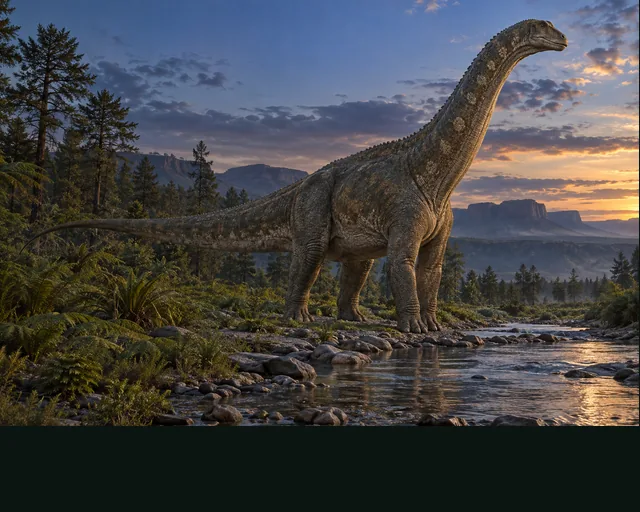
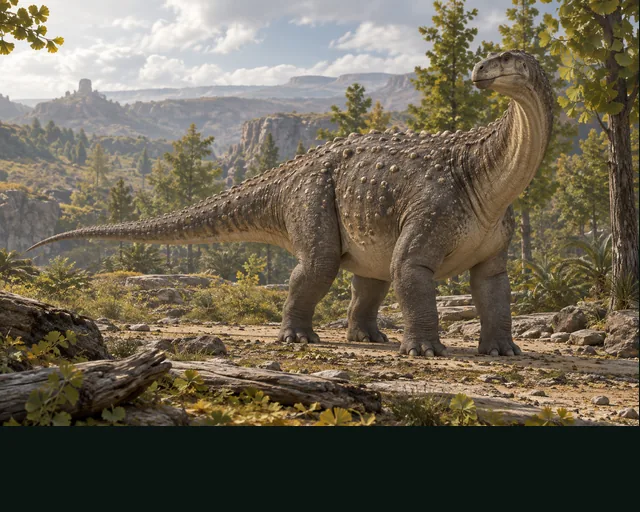
The complete, named reference supplies the raised neck, small head, four-legged torso and tapering tail used in the illustration. Scutes, colours and fine body proportions remain artistic interpretations. These details are not new evidence for the uncertainly associated fossils.
Compare Alamosaurus and Saltasaurus, then explore the B names.
Quick answers
- What kind of dinosaur was Borealosaurus?
- It was a Cretaceous sauropod from China, generally discussed among titanosaurian or closely related titanosauriform dinosaurs.
- Is its complete skeleton known?
- The name-bearing evidence is fragmentary, and some separately referred bones cannot be securely associated with it.
- How big was it?
- We do not give an exact length or mass from the limited and uncertainly associated material reviewed here.
- Why is there no precise age here?
- The consulted records do not give a consistent, independently checked numerical age. The broad Cretaceous label avoids false precision.