Jurassic Dinos editorial · Updated · Source-based review
What was Bonapartesaurus?
Bonapartesaurus was a duck-billed plant-eater from Patagonia in Argentina. Its full species name is Bonapartesaurus rionegrensis. The genus honours palaeontologist José Bonaparte, while the species name points to Río Negro, the province where its fossils were found. Its story shows how important it is to keep track of exactly which bones belong to a scientific name.
Where does the evidence come from?
The 2017 description centres on MPCA-Pv SM2, a partial articulated skeleton from Salitral Moreno. Articulated means that at least some bones remained connected in their natural arrangement. That is useful information, but it does not mean that every body part was preserved.
The authors assigned its rocks to the Allen Formation and a late Campanian–early Maastrichtian age, within the Late Cretaceous. Their geological discussion describes river-related deposits. The place where remains were buried can help reconstruct an environment, although a fossil does not record an animal’s entire lifetime or daily routine.
What made its body distinctive?
Tall projections rose from vertebrae around the hips and front of the tail. These are neural spines, parts of the backbone rather than loose spikes sitting on the skin. The museum account also highlights robust hindfeet.
Such details help specialists compare hadrosaur skeletons. However, there is still a difference between a bony projection and the final outline of a living back. Muscles, skin and their colours are not supplied automatically by the name of a bone.
Why did its identification change?
Before being named Bonapartesaurus, the specimen had passed through other assignments, including association with material called Willinakaqe. Re-examination found that the material needed more careful separation. One label on a collection is not a guarantee that every specimen under it represents the same animal.
The original analysis also explored relationships and possible movements of hadrosaurs between continents. Those are testable evolutionary explanations. They should not be retold as a known route followed by this particular individual.
What is interpretive in the illustration?
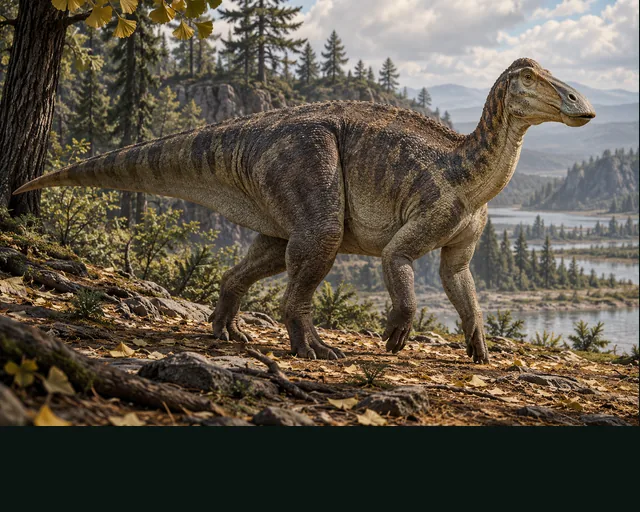
Our image follows a complete, explicitly named restoration with a blunt head, substantial four-legged body and long tail. The illustrated head, patterned skin and exact back outline go beyond the preserved type skeleton, so we keep them labelled as artistic interpretation. No spectacular hollow head crest has been added.
Read about Edmontosaurus and Parasaurolophus, then visit the B section of the dinosaur directory.
Quick answers
- Where did Bonapartesaurus live?
- Its type specimen comes from the Salitral Moreno area of Río Negro, Argentina, in Late Cretaceous Allen Formation rocks.
- Why does it have a high back in art?
- Tall vertebral spines are part of its described anatomy; the finished external contour still requires artistic interpretation.
- Was its head found with the type skeleton?
- The reviewed type is a partial body skeleton, so a complete living head is not directly documented by that specimen.
- Does its name mean it was enormous?
- The name honours José Bonaparte. A name is not a body-size measurement.