Jurassic Dinos editorial · Updated · Source-based review
What was Bolong?
Bolong was a beaked, plant-eating dinosaur from Early Cretaceous China. Its species is Bolong yixianensis. Researchers place it among early hadrosauroids: members of the wider evolutionary branch that later included the familiar duck-billed dinosaurs. Calling it an early branch does not mean that it was the direct ancestor of every later duckbill.
Where were its fossils found?
The type specimen, YHZ-001, came from the Yixian Formation in western Liaoning. A detailed anatomical chapter by Wu and Godefroit describes its head, teeth and body bones. The genus name honours the people who discovered and excavated that specimen, and the species name recalls Yixian.
Another study examined a very young individual from Ningcheng, Inner Mongolia. These are separate places and separate animals. A geological formation can extend across an area, so a formation name alone is not a street address for every fossil found within it.
How do scientists recognise a young dinosaur?
The juvenile, ZMNH M8812, was preserved almost complete on a slab. Researchers considered its short, deep skull and the way some backbone joints had not fused. Microscopic examination of its bone tissue also supported a very early growth stage.
Using several kinds of evidence is more reliable than simply choosing the smallest fossil. A small skeleton might belong to a young individual, a naturally small species, or an incomplete animal whose size is misleading.
Did its proportions stay the same?
The juvenile study identified changes in tooth rows and in the relative proportions and robustness of limb bones. Growing a Bolong was therefore not like enlarging a photograph: some parts changed faster than others.
This matters when comparing fossils. Two individuals with different-looking cheeks or forearms might represent different ages rather than different species. Scientists need an explanation that fits the whole set of observations, including which parts were damaged during fossilisation.
What does the living illustration show?
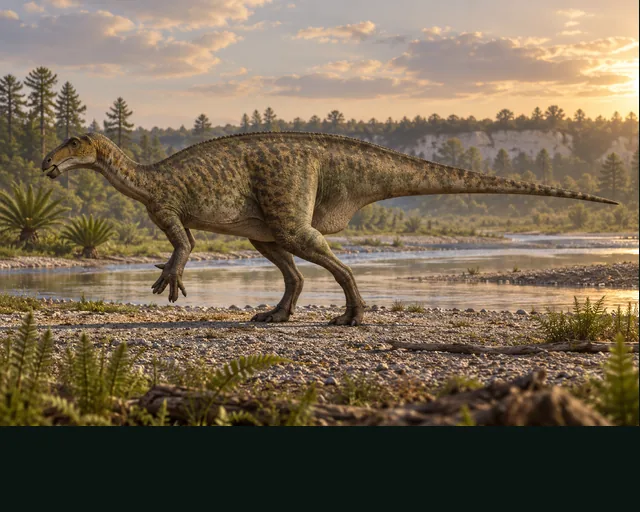
Our restoration follows TotalDino’s complete, explicitly named Bolong artwork. The low beaked head, rounded trunk, four-limbed stance and long tail come from that reference. We did not use the fossil slab as instructions for inventing missing external anatomy. Skin colours, the forest and the precise walking posture remain artistic choices.
Compare Iguanodon and Mantellisaurus, or continue through the A–Z directory under B.
Quick answers
- Was Bolong a duck-billed dinosaur?
- It was an early hadrosauroid, on the broader branch that includes duck-billed dinosaurs, rather than a late specialised hadrosaurid.
- Where were its fossils found?
- The type came from western Liaoning; a separate early juvenile was reported from Ningcheng in Inner Mongolia.
- How do we know a specimen was young?
- The juvenile study combined skull shape and bone-joint observations with microscopic bone-tissue evidence.
- Can an adult be made by enlarging the juvenile?
- No. The proportions of teeth, skull and limbs change as an animal grows.