Jurassic Dinos editorial · Updated · Source-based review
What was Blasisaurus?
Blasisaurus was a plant-eating duck-billed dinosaur from what is now northeastern Spain. It belonged to the lambeosaurines, the hadrosaur group famous for elaborate head crests. Its species, Blasisaurus canudoi, was named in 2010. The most useful clues to its identity are much smaller than a whole dinosaur: they include pieces of the cheek and lower jaw.
Where and when did it live?
The described material came from Blasi 1 near Arén, in Huesca, within the Spanish Pyrenees. Its rocks belong to the upper Arén Formation and the late Maastrichtian, near the end of the Cretaceous. A formation is a recognisable package of rocks that geologists can follow and compare between places.
Europe at that time was divided by seas. Researchers discuss these dinosaurs when investigating how animals reached the ancient European islands. A possible migration route is a scientific explanation to test, rather than a journey we watched an individual Blasisaurus make.
How can a cheek bone identify a dinosaur?
The jugal is a cheek bone below the eye. The original description highlighted its unusual combination of shapes. A later reassessment refined the diagnosis, retaining distinctive cheek-bone features while removing an opening’s outline as a reliable standalone character.
This is a helpful detective lesson: a good identification considers several connected clues. One shape may depend on neighbouring bones or vary between individuals. Revising a diagnosis can make a dinosaur’s identification clearer without requiring the name to disappear.
Was its entire body found?
The reviewed fossil account lists disarticulated skull and lower-jaw material. Disarticulated means that the pieces were no longer joined in their original positions. The name-bearing fossil is a left jugal, not a complete head-to-tail skeleton.
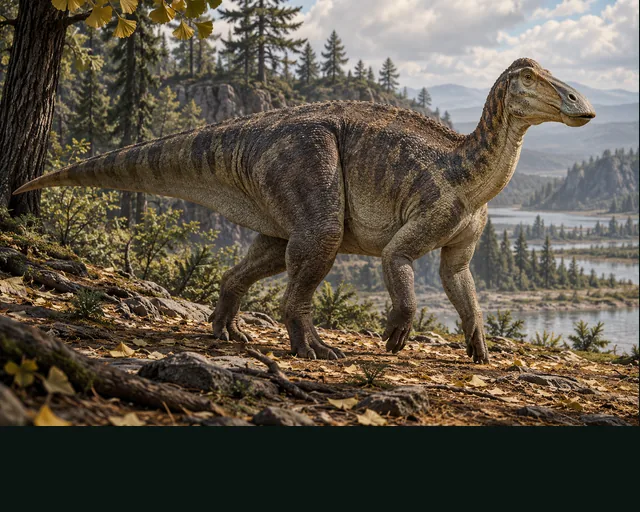
We therefore avoid an exact body length or a confident description of its finished crest. Recognising its broader dinosaur group does not magically preserve missing parts. A crest drawn in an illustration is not a new fossil observation.
How should you read our restoration?
Our image follows the credited complete Blasisaurus artwork: a low beaked head, deep body and long tapering tail. It provides a coherent living appearance while keeping the reference artist’s uncertainties. The skin pattern, colours, crest completion and peaceful river setting are artistic decisions.
Try comparing Parasaurolophus with Edmontosaurus to see how different hadrosaur heads can appear, then return to the B names in the A–Z directory.
Quick answers
- Where was Blasisaurus found?
- Its named fossils came from Blasi 1 near Arén in Huesca, northeastern Spain.
- Was a complete animal discovered?
- The reviewed description centres on disarticulated skull and lower-jaw remains, rather than a complete body.
- What is a jugal?
- It is a cheek bone. Its shape helps researchers compare the skulls of different dinosaurs.
- Do we know its exact crest shape?
- The material reviewed here does not establish the complete external crest shown in a living restoration.