Jurassic Dinos editorial · Updated · Source-based review
Bicentenaria argentina was a small carnivorous coelurosaurian dinosaur from Patagonia, Argentina. Coelurosauria is a broad theropod branch that includes many familiar feathered dinosaurs and birds. Bicentenaria helps researchers investigate that branch’s early radiation without representing a complete snapshot of its entire ancestry.
Put the fossil in the right period
Novas and colleagues’ 2012 description places the material in the upper levels of the Candeleros Formation, identified as Cenomanian. That is early in the Late Cretaceous. An older overview used during candidate research incorrectly labelled it Early Cretaceous; the original study takes priority here.
The locality is on the eastern shore of the Ezequiel Ramos Mexía Reservoir in Río Negro Province. A modern reservoir identifies the present place, not the ancient environment or a feature that existed when the animal lived.
Which bones belong to the type?
The holotype, MPCA 865, comprises the rear part of a skull articulated with the lower jaws. The paper lists a separate assemblage of paratype material containing many additional bones.
A holotype is the specimen anchoring a scientific name. Other assigned material can expand anatomical knowledge, but should not be silently combined into one complete individual. Keeping specimen numbers and associations clear is essential before comparing body parts or proposing behaviour.
What does an assemblage prove?
Several individuals or body parts at one locality can support questions about accumulation, growth and possible sociality. They do not automatically prove coordinated pack hunting. A deposit may form through different processes, and an attractive social story requires its own evidence.
For the same reason, a group painting is not an observation of prehistoric behaviour. This page avoids copying a dramatic interaction into the scientific account simply because it appears in an illustration.
We also leave exact body length and mass out of the facts panel rather than presenting comparison-based estimates as direct measurements of a whole animal.
Our complete individual reference
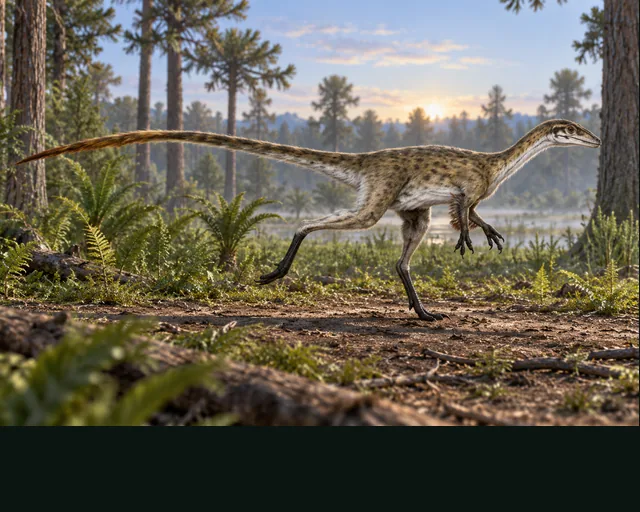
Lucas-Attwell’s named artwork provides a clear complete Bicentenaria individual. It shows a low elongated head and neck, slender bipedal body, clawed forearms, long hind limbs and a complete balancing tail. Fine head and hand detail, colour and covering remain artistic interpretations.
The new cinematic scene follows that whole individual rather than generating anatomy from the skull or a different coelurosaur. Compare Coelurus and Compsognathus as separate accounts, then explore the A–Z directory. Similar body plans can accompany very different fossil histories.
Quick answers
- When did Bicentenaria live?
- In the Cenomanian, early in the Late Cretaceous, according to the original Candeleros Formation description.
- Was the type specimen a whole animal?
- No. MPCA 865 preserves the rear part of the skull with lower jaws; other material is listed separately.
- Does a group of fossils prove pack hunting?
- No. Assemblage evidence and coordinated hunting behaviour are different questions.
- Can a group painting establish social behaviour?
- No. Our new image shows one complete individual and makes no claim about a witnessed interaction.