Jurassic Dinos editorial · Updated · Source-based review
Bellusaurus sui was a sauropod from the Shishugou Formation of northwestern China. It is known through a bonebed containing many young individuals, including useful skull material. That combination makes it valuable for studying anatomy and growth, while leaving the animal’s adult size uncertain.
What does a juvenile bonebed contain?
Moore and colleagues’ 2018 study describes material from more than a dozen juvenile individuals. A juvenile is a young animal that has not completed its growth. The collection includes numerous skull elements as well as body bones.
A bonebed is an assemblage, not automatically a preserved social group. The deposit does not by itself prove that these dinosaurs formed a family herd or died while behaving together. Researchers must investigate how bones accumulated and how the individuals relate.
Why are the skulls important?
Sauropod skulls can provide anatomical information that is absent from a collection of large limb bones. The study documents distinguishing features across several cranial elements and considers how some features may change with age.
A growth-related difference can complicate classification. Yet youth does not make a fossil scientifically uninformative. Some characters can remain useful even when others need to be interpreted in an ontogenetic context. Ontogenetic means related to development during life.
Is Bellusaurus just the young of another genus?
The authors compared Bellusaurus with other Chinese sauropods and argued that it is diagnosable rather than simply juvenile Klamelisaurus. This question cannot be settled by matching two paintings or assuming that a small skeleton must belong to a familiar giant.
The same caution applies to size. A young individual’s length cannot be advertised as a secure adult maximum, and multiplying it by an arbitrary factor would not solve the problem. We leave precise adult length and mass open here.
The cited anatomical study describes the Shishugou context as Middle–Late Jurassic. This page retains that broad source context rather than filling a numerical age field from an unrelated summary.
Reading the restoration
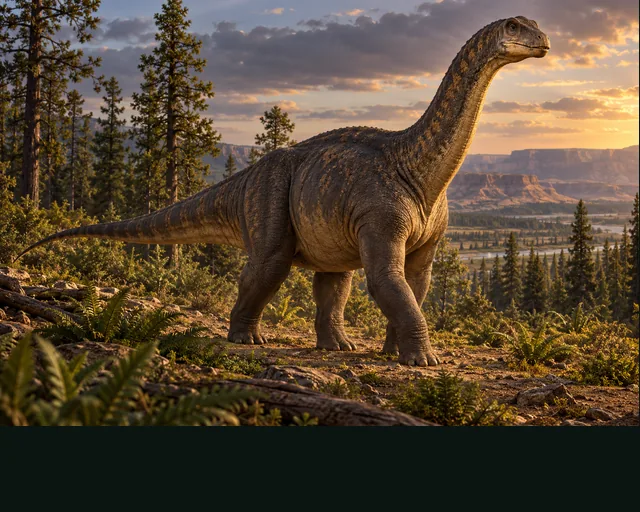
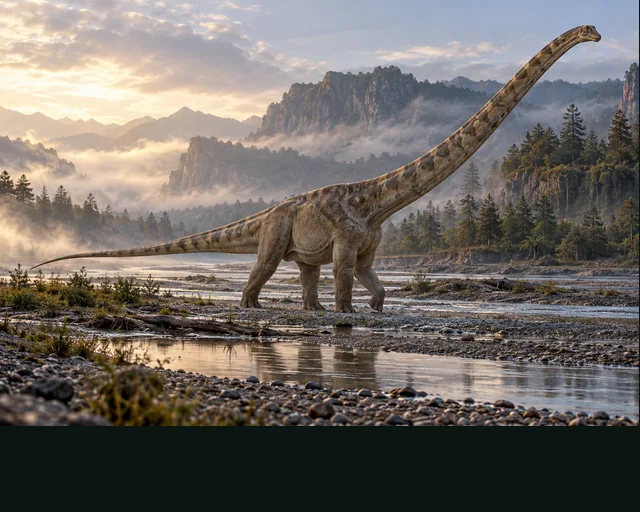
Andrey Atuchin’s complete named artwork supplies our visual reference: a small head, moderately rising neck, broad body on four weight-bearing legs and a long upward-curving tapering tail. The image does not establish adult dimensions, skin or colour. Our new scene follows the whole named restoration instead of inventing a body from juvenile bones.
Compare Camarasaurus and Mamenchisaurus, then explore the A–Z directory. A young dinosaur can answer important questions without standing in for a fully known adult.
Quick answers
- Were the known Bellusaurus individuals adults?
- The bonebed discussed in the 2018 study contains juvenile individuals.
- Can their size give an adult maximum?
- No. Young individuals do not establish a precise full-grown size.
- Is Bellusaurus merely juvenile Klamelisaurus?
- The detailed 2018 comparisons argue that Bellusaurus is diagnosable and not simply a juvenile of Klamelisaurus.
- Does a bonebed prove a social herd?
- No. An assemblage can preserve several animals without documenting their social relationships.