Jurassic Dinos editorial · Updated · Source-based review
Beishanlong grandis was a large ornithomimosaurian dinosaur from Early Cretaceous China. Ornithomimosaurs are often nicknamed ostrich-mimic dinosaurs, but they were not ostriches. This animal is particularly useful for understanding why a big fossil does not necessarily represent a fully grown adult.
Where was it discovered?
Makovicky and colleagues described associated partial postcranial material from the Xinminpu Group of northern Gansu. Postcranial means behind the skull. The original study places it in the Aptian–Albian part of the Early Cretaceous.
The research appeared online in April 2009 and in a January 2010 journal volume. These dates describe the publication history of the same work. They should not create two naming events or imply that a second animal was discovered.
How do we know it was growing?
The authors examined bone histology, the microscopic structure of tissue, and found evidence that the type individual was still growing at death. Other skeletal features also informed their maturity assessment.
This matters when comparing size. A large subadult documents an animal that had already reached substantial dimensions, but does not supply its eventual adult maximum. A mathematical mass estimate is also an estimate based on a model, not a fossil animal placed on scales.
This page therefore avoids a precise adult maximum and a changing “second-largest” ranking. A record depends on which specimens, methods and uncertainties are being compared.
Does ostrich-mimic establish its diet?
No. A nickname describing a broad body-plan resemblance cannot identify every food eaten by an extinct dinosaur. The reviewed study discusses relationships and possible ecological implications, but it does not preserve a complete menu for this individual.
We keep the exact diet open rather than copy the habits of living ostriches or better-known relatives. Shared membership in Ornithomimosauria is a useful starting point for comparison, not a substitute for species-specific evidence.
Our feathered reconstruction
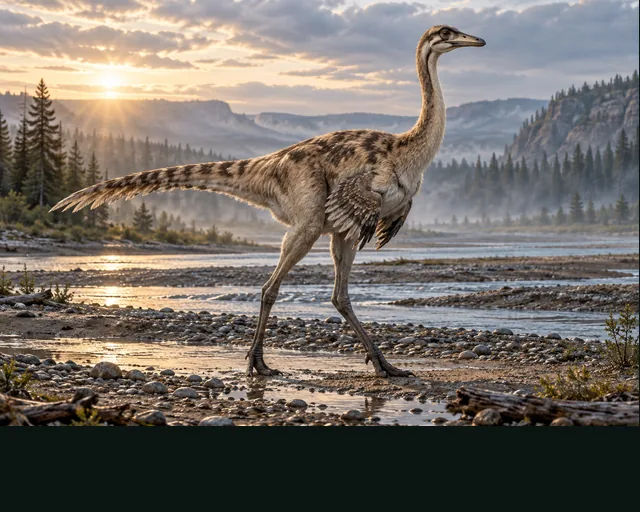
Nobu Tamura’s complete named Beishanlong restoration supplies the visual reference: a small narrow head, long rising neck, grasping forelimbs, powerful hind limbs and a long feathered tapering tail. Feather extent, colours and restored head and body proportions remain artistic interpretations beyond the partial fossil.
The new cinematic scene follows that whole animal and does not infer missing parts from postcranial photographs. Compare Gallimimus and Ornithomimus, then browse the A–Z directory. Growth evidence can make a familiar size comparison much more interesting—and much less absolute.
Quick answers
- Was Beishanlong an ostrich?
- No. It was an ornithomimosaurian theropod, part of the group nicknamed ostrich-mimic dinosaurs.
- Was the type individual fully grown?
- The original histological study indicates that it was still growing when it died.
- Did researchers find its complete skull?
- The described type is partial postcranial material; the complete head in the image is reconstructed.
- Was it definitely the second-largest ornithomimosaur?
- This page avoids a current ranking without a consistent, updated dataset and explicit size uncertainties.