Jurassic Dinos editorial · Updated · Source-based review
Beibeilong sinensis was a caenagnathid oviraptorosaur from Late Cretaceous China. The discovery behind the name combines large eggs with a very small dinosaur. That contrast is interesting because the tiny individual is not a miniature adult whose proportions can simply be enlarged.
What was the specimen?
Pu and colleagues described Beibeilong in 2017 from a partial clutch of large eggs associated with a young theropod skeleton. The paper uses embryo and perinate terminology. A perinate is an animal at or near hatching or birth.
The association helps connect a skeletal dinosaur identity with an egg type. It does not provide a complete adult skeleton. A large adult is an inference discussed by the researchers, not an excavated giant lying beside the eggs.
Why are eggs and animals named differently?
An egg-form name describes fossil eggs according to their own features. A biological dinosaur genus describes the animal. Connecting the two is especially valuable when identifiable skeletal remains occur in close association.
However, that connection should not be stretched into a claim that every similarly shaped giant egg from another locality or continent belonged to Beibeilong. Similar egg structure is evidence to investigate, not an automatic genus label for every nest.
Can we know the adult’s size?
The original study argues for a large adult caenagnathid. Yet the adult body was not directly measured from this young specimen. Comparisons with other giant oviraptorosaurs do not turn another animal’s dimensions into measured Beibeilong anatomy.
We therefore do not give a precise adult maximum or an unsupported mass. Growth can change proportions as well as overall size. The same caution applies to a detailed menu, nesting behaviour or an assumed family scene.
How was the adult picture made?
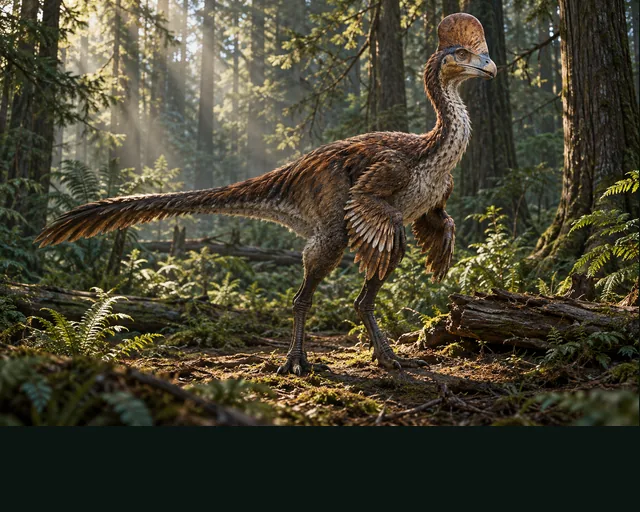
PaleoNeolitic’s complete restoration explicitly labelled Beibeilong supplies our visual reference. It depicts a short deep beaked head on a long neck, a feathered body, winglike forelimbs, long hind legs and a curved feathered tail. Adult proportions and plumage remain largely interpretive.
Our workflow follows that existing complete named animal rather than trying to invent an adult directly from an embryo, fossil bones or a relative’s image. The independent scene is clearly labelled as AI artistic reconstruction. It is not proof that an adult with those exact colours or proportions was recovered.
Compare Anzu and Oviraptor for other oviraptorosaur accounts, then return to the A–Z directory. A small fossil can illuminate a giant story while leaving the giant’s exact appearance uncertain.
Quick answers
- Was a giant adult skeleton found?
- No. The described association contains a very young individual and eggs; adult size is inferred.
- What is a perinate?
- An animal at or close to hatching or birth; the paper also describes the individual as an embryo.
- Does every giant egg belong to Beibeilong?
- No. An egg-form name alone does not securely assign every similar nest to this biological genus.
- What does the adult image represent?
- A complete named artist’s interpretation, with adult proportions and plumage explicitly uncertain.