Jurassic Dinos editorial · Updated · Source-based review
Baurutitan britoi was a Late Cretaceous titanosaur from Brazil. Its original type material is a useful sequence of vertebrae near the pelvis and along the tail. Later discoveries prompted a wider naming debate, making this an animal whose specimens need to be tracked as carefully as its name.
What was described in 2005?
Kellner, Campos and Trotta described specimen MCT 1490-R as a final sacral vertebra followed by eighteen tail vertebrae. The material came from the Peirópolis region near Uberaba, Minas Gerais. Current regional work places the locality within the Serra da Galga Formation.
A sequence preserves useful relationships between neighbouring bones. It does not, however, supply a complete skull, neck, limb skeleton or living outline. A beautiful whole-body image must therefore be distinguished from the fossil inventory.
Why did other names enter the story?
Silva Junior and colleagues’ 2022 study described new material and proposed that Trigonosaurus pricei should be treated as a junior synonym of Baurutitan britoi. The same study separated a different formerly referred tail series as Caieiria allocaudata.
Those are specimen-specific proposals. They do not mean that every bone once given any of the three labels can be combined into one unquestioned skeleton. The distinction between a name-bearing specimen and referred material remains important.
Is the reassignment settled?
A 2025 review discusses later anatomical work supporting a distinction between Trigonosaurus and Baurutitan. This account therefore identifies the 2022 synonymy as a proposal rather than presenting it as unanimous agreement.
Scientists can disagree about whether the preserved differences are sufficient to separate taxa. Readers do not need a false certainty to understand the issue: the question concerns which specimens can reliably be grouped together. We avoid automatic merges, pooled dimensions and an invented complete body based on whichever interpretation produces the biggest animal.
Following the complete artwork
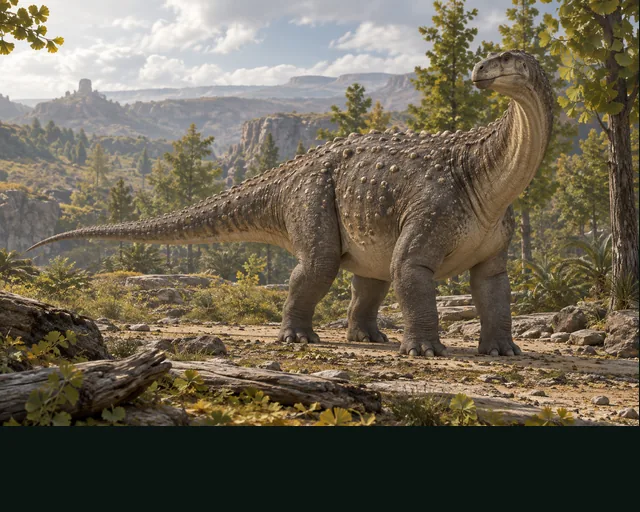
LancianIdolatry’s named whole-body restoration supplies our visual reference. It depicts a small blunt head on a tall rising neck, a heavy torso on four columnar limbs and a long tapering tail. Dark colouring, posture, soft tissues and full-body proportions remain artistic interpretations.
Our new cinematic scene follows that complete restoration, not the vertebral series or another titanosaur used as a substitute. It does not claim an exact adult maximum or a preserved favourite food.
Compare Saltasaurus and Argentinosaurus, then return to the A–Z directory. A careful specimen history can explain why a dinosaur account changes without pretending the underlying evidence has become complete.
Quick answers
- What was the original type material?
- A final sacral vertebra followed by a sequence of eighteen tail vertebrae, catalogued as MCT 1490-R.
- Was Trigonosaurus definitely merged into Baurutitan?
- A 2022 study proposed synonymy, but later anatomical work disputes it. This page keeps the proposal qualified.
- Where did Baurutitan live?
- In Late Cretaceous Brazil, represented by the Serra da Galga Formation near Peirópolis, Uberaba.
- Does the whole-body image show what was discovered?
- No. It follows a complete named artistic restoration beyond the preserved type series.