Jurassic Dinos editorial · Updated · Source-based review
Batyrosaurus rozhdestvenskyi was a plant-eating hadrosauroid from Late Cretaceous Kazakhstan. Its partial remains are useful for studying relationships near the duck-billed dinosaur radiation. They also offer a chance to explain how researchers infer possible abilities without claiming to have watched an animal move.
The fossil behind the name
Godefroit and colleagues described specimen AEHM 4/1 from the Bostobinskaya Svita of central Kazakhstan in 2012. The source consulted here is the institution-hosted chapter proof, which is explicitly labelled as an uncorrected version. Its abstract identifies a fragmentary specimen with diagnostic cranial features.
Fragmentary does not mean useless. A partial skull can contain several informative structures, but it is not a complete skeleton. The page therefore avoids a precise whole-body length or mass derived from a reconstructed silhouette.
Hadrosauroid or hadrosaurid?
The original analysis placed Batyrosaurus as a basal hadrosauroid outside Hadrosauridae under the definition adopted in that study. Those terms refer to different boundaries on a family tree. Treating them as exact synonyms would hide the question the study was testing.
A proposed relationship also should not be replaced with a simple resemblance. Sharing a broad geological unit with another historically named dinosaur does not establish that their names are synonyms. This account does not automatically merge Batyrosaurus with Arstanosaurus.
What did the inner ear suggest?
The chapter discusses the semicircular canals of the inner ear and proposes that their form is consistent with an agile biped. That is a functional interpretation based on anatomy. It is not a measured running speed or proof that the animal always moved on two legs.
Brain-cavity information likewise must not be described as preserved brain tissue. A cavity can help investigate the structures it enclosed, but the space and the original organ are not identical evidence. Keeping that distinction clear makes the inference more understandable rather than less interesting.
Interpreting the complete image
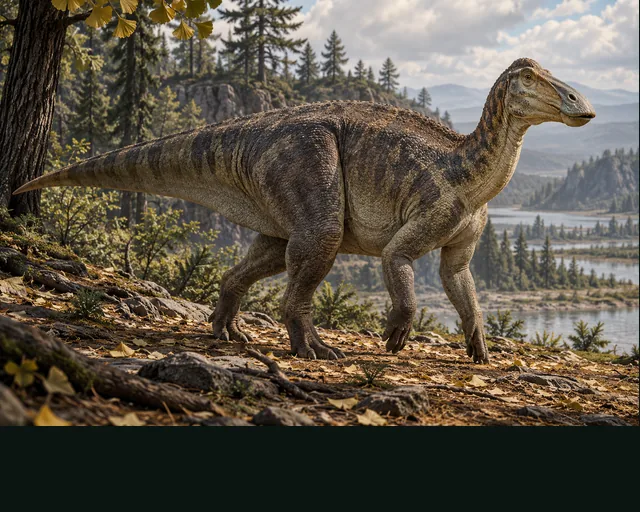
Miracusaurs’s complete named restoration supplies our visual reference: a broad low beaked head, a deep body with shorter forelimbs, robust hind limbs and a long deep tapering tail. Proportions, soft tissues, posture and colours remain artistic interpretations. The new scene follows that whole animal rather than assembling a body from cranial or limb fossils.
Compare Iguanodon and Edmontosaurus for separate ornithopod accounts, then return to the A–Z directory. An anatomical clue can support a hypothesis while leaving plenty still to discover.
Quick answers
- Where did Batyrosaurus come from?
- Central Kazakhstan, in the Bostobinskaya Svita according to the original description.
- Was it a fully derived duck-billed hadrosaurid?
- The original analysis placed it as a basal hadrosauroid outside Hadrosauridae under the definition used there.
- Did scientists find its brain?
- No preserved brain tissue is established here. Brain-cavity and inner-ear evidence must be distinguished from the brain itself.
- Does its inner ear prove a running speed?
- No. The authors’ agility interpretation is a functional hypothesis, not a measured speed.