Jurassic Dinos editorial · Updated · Source-based review
Bashanosaurus primitivus was a stegosaur from Middle Jurassic China. It helps researchers investigate a poorly sampled part of stegosaur history. Its name includes primitivus, but an early-diverging animal is not an unfinished version of a later dinosaur.
Where was it discovered?
Dai and colleagues described material from the Lower Member of the Shaximiao Formation in Yunyang, Chongqing. Their 2022 study used uranium–lead dates from zircon grains in horizons bounding the quarry to support a Bajocian age.
Those dates constrain the geological setting. They do not directly measure the age in years of the animal when it died. Keeping geological age and individual age separate prevents two very different uses of the word old from becoming confused.
Why was the anatomy useful?
The study described distinctive features in the back vertebrae, shoulder region, thigh bone and armour. Some characters resemble conditions in earlier armoured dinosaurs, while others support a stegosaur identity. A combination of features can therefore clarify an evolutionary question without requiring one spectacular structure.
The Natural History Museum’s account describes incomplete specimens and a limited set of preserved armour pieces. A few plates and spines can be scientifically informative without preserving every plate in its living position.
Was it the oldest stegosaur?
The original paper and museum announcement placed Bashanosaurus among the earliest known stegosaurs in 2022. Such a claim depends on available fossils and their age assessments. New discoveries can change a record, so this account retains the date and the qualifying language.
An early branch on a family tree also does not establish Bashanosaurus as the direct ancestor of every later stegosaur. Relationships are tested by comparison, and a close branch is not automatically a literal ancestor.
The museum notes that the most complete individual may have been juvenile. Its estimated size should therefore not be advertised as a secure adult maximum.
The whole-body restoration
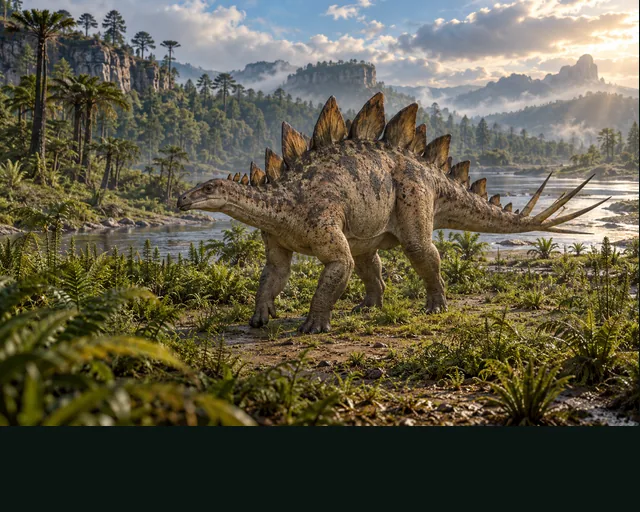
Ddinodan’s complete named artwork supplies our image reference: a small narrow low head, quadrupedal body, two rows of back plates and a tapering tail with pointed spikes. Exact plate arrangement, spike placement, skin and colours remain interpreted elements of that reference. The new scene follows the whole restoration rather than generating missing anatomy from fossil armour.
Compare Huayangosaurus and Stegosaurus for other stegosaur accounts, then browse the A–Z directory. The important discovery is a better-supported evolutionary question, not merely another winner in an oldest-dinosaur ranking.
Quick answers
- Where did Bashanosaurus live?
- In what is now Chongqing, China, represented by the Lower Member of the Shaximiao Formation.
- Was it one of the earliest stegosaurs?
- The 2022 study interpreted it as one of the earliest records, using a Middle Jurassic age supported by dated bounding horizons.
- Was the complete plate arrangement preserved?
- Some armour was found, but the complete arrangement shown in the artwork remains a reconstruction.
- Was the small specimen definitely a full-grown adult?
- The museum article notes that the most complete individual may have been juvenile; its estimated size is not an adult maximum.