
Jurassic Dinos editorial · Updated · Source-based review
Barsboldia sicinskii was a hadrosaurid dinosaur from the Late Cretaceous Nemegt Formation of Mongolia. Its striking feature concerns the spine, not a known elaborate skull crest. The fossil also shows why a paper’s historical classification should not be repeated as though later research never happened.
What did the original description contain?
Maryańska and Osmólska named Barsboldia from an incomplete postcranial skeleton. Postcranial means behind the skull. Their paper highlighted unusually tall, club-like neural spines, the upward-projecting parts of vertebrae.
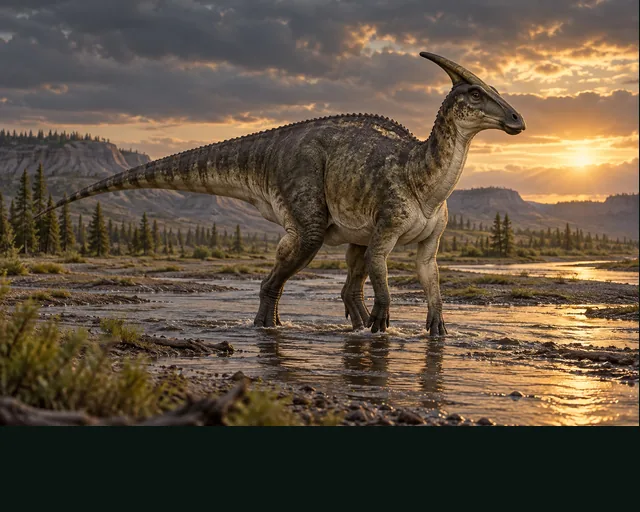
The original study interpreted the animal as a lambeosaurine. That was an anatomical hypothesis based on the material available, not evidence that a hollow crest had been discovered on a missing head. A familiar group label must not supply a fossil structure that the specimen does not preserve.
What changed in the reappraisal?
Prieto-Márquez’s 2011 analysis revised the diagnosis and tested relationships using a broader anatomical comparison. It did not support the earlier lambeosaurine placement, instead recovering Barsboldia as a basal saurolophine hadrosaurid.
The evidence included features of the ilium, a major pelvic bone, together with vertebral anatomy. A change in the interpretation of such characters can alter a family-tree result without changing the bones themselves.
Does a tall spine mean a sail?
Tall vertebral projections affect the framework of the back, but the exact living soft-tissue profile remains a reconstruction. A painting may show a pronounced ridge; it does not establish the complete skin outline, colour or function of that ridge.
Neural spines are also not separate horns sticking out through the skin. Distinguishing a bony structure from the outward appearance it supports helps readers avoid treating a diagram, a skeleton and a living restoration as identical kinds of evidence.
Following the named complete artwork
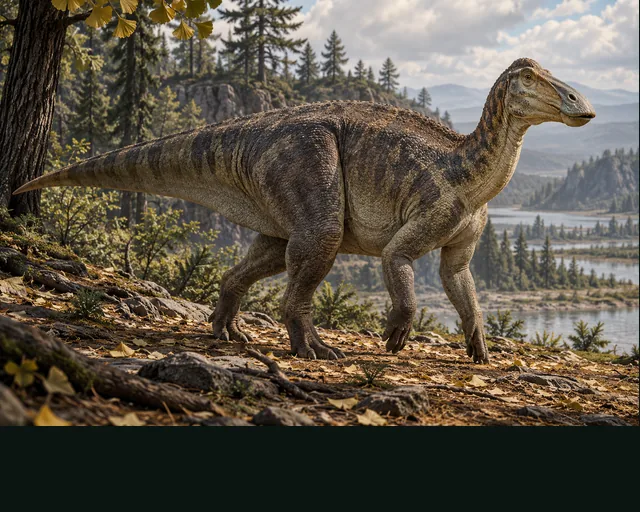
Dmitry Bogdanov’s complete Barsboldia restoration supplies our visual reference: a broad low beaked head, deep four-legged torso, tall back ridge and long deep tapering tail. Its skull shape, ridge soft tissues and colours remain interpreted. The source’s older lambeosaurid label does not override the later research discussed here.
Our independent cinematic scene follows that complete living form, not a speculative body assembled from vertebrae or another hadrosaur. We do not calculate an exact maximum size from the illustration.
Compare Saurolophus and Edmontosaurus as separately documented hadrosaur accounts, then return to the A–Z directory. Classification is a question to test with anatomy, not a crest to add because a name sounds familiar.
Quick answers
- Where was Barsboldia found?
- In the Nemegt Formation of Mongolia’s Gobi Desert.
- Was it definitely a lambeosaurine?
- That was the original assignment; the 2011 reappraisal instead recovered it as a basal saurolophine hadrosaurid.
- Does the back ridge prove a head crest?
- No. The described postcranial specimen does not preserve a skull crest.
- What were the tall spines?
- They were neural spines projecting upward from vertebrae, not a row of separate external horns.
.jpg)