Jurassic Dinos editorial · Updated · Source-based review
Baiyinosaurus baojiensis was an early-diverging stegosaur from Middle Jurassic China. Its name was introduced in 2024, but its importance is not simply being a new name. Skull and vertebral features help researchers investigate the early history of the armoured dinosaur branch.
Where did it come from?
The type specimen was found in the Pingchuan District of Baiyin City, Gansu Province. The original study places it in the Straw-yellow Sandstone Member of the Wangjiashan Formation, considered late Bathonian in age.
That geological setting falls within the Middle Jurassic. It is more useful to retain that source-based context than attach an unverified exact numerical date. Regional “first” or “only” claims can also change with discoveries, so they are not the focus of this account.
What was actually preserved?
The original inventory includes a partial cranium, one neck vertebra, seven back vertebrae and one tail vertebra. It is a partial skeleton, not a complete armoured animal.
The description identifies a distinctive frontal, a bone in the skull roof, together with a combination of vertebral features. Some resemble conditions in earlier-branching thyreophorans, the wider armoured dinosaur group. These comparisons support the authors’ interpretation of Baiyinosaurus as transitional in morphology.
Transitional does not mean half an animal or an unfinished design. It means that the combination of features helps scientists investigate changes between branches of an evolutionary tree.
What does its position mean?
The analysis places Baiyinosaurus among early-diverging stegosaurs. It does not establish it as the direct ancestor of Stegosaurus or any other particular dinosaur. A branch can clarify evolutionary history without being the literal ancestor preserved in a straight line.
The skull and vertebrae also do not reveal a complete arrangement of back plates and tail spikes. Stegosaur identity gives a context for research, but it cannot turn every detail in a painting into a recovered fossil feature.
Understanding the image
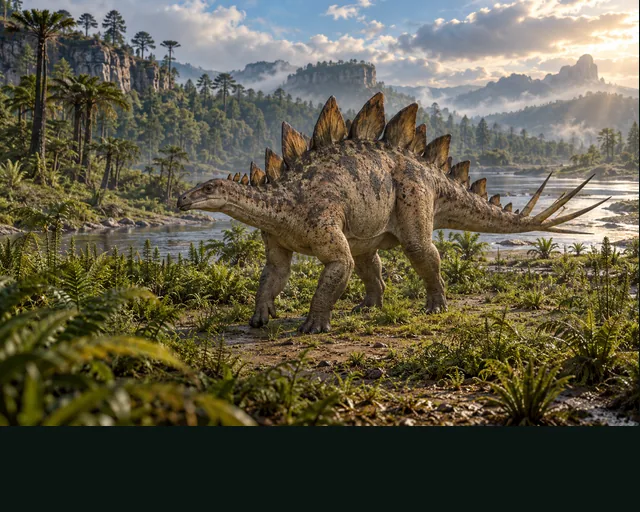
Ddinodan’s complete named restoration supplies our whole-body visual reference. It shows a small low head, a long neck, a quadrupedal body, pointed back plates and a spiked tail. Plate shape, placement, covering and colour are interpreted elements of that source artwork. The new illustration follows the complete living restoration rather than constructing an animal from vertebral photographs.
Compare Huayangosaurus and Stegosaurus to explore other stegosaur accounts, then return to the A–Z directory. Comparing what each fossil actually preserves is more revealing than assuming every plate-bearing dinosaur was alike.
Quick answers
- Where was Baiyinosaurus found?
- In Baiyin City’s Pingchuan District, Gansu Province, China.
- What was preserved?
- A partial cranium, one neck vertebra, seven back vertebrae and one tail vertebra in the described type specimen.
- Were complete rows of plates discovered?
- The type inventory does not preserve a complete back-to-tail armour arrangement. The image’s arrangement follows a named artistic restoration.
- Was it Stegosaurus’s direct ancestor?
- The study places it among early-diverging stegosaurs, but does not establish a direct ancestor–descendant link to Stegosaurus.