
Jurassic Dinos editorial · Updated · Source-based review
Bagualosaurus agudoensis was a Late Triassic sauropodomorph from southern Brazil. Sauropodomorphs include the lineage that later produced giant sauropods, but Bagualosaurus was not simply a miniature version of a long-necked Jurassic giant. Its anatomy helps reveal that body plans change in combinations rather than all at once.
Where does it fit in time?
The original description places the fossil in the Candelária Sequence of the Santa Maria Formation and identifies it with the Carnian part of the Late Triassic. The paper appeared online in 2018 and in a 2019 journal volume. Those publication dates refer to the same study, not two discoveries.
Geological names locate the fossil in a rock sequence. They do not establish that it met every other animal known from the region. This page avoids an exact numerical age where the broad geological context answers the question more reliably.
What combination did researchers notice?
Pretto, Langer and Schultz described skull, lower-jaw and dental features approaching conditions found in some later sauropodomorphs. The body skeleton, meanwhile, retained more similarities to early dinosaurs living around the same time.
Different anatomical regions can therefore tell different parts of an evolutionary story. A skull need not change at exactly the same pace as the limbs. Calling that a mosaic does not mean the animal was assembled from unrelated creatures; it means that its features do not all match one simplified evolutionary stage.
Was it the direct ancestor of giant sauropods?
The reviewed research does not identify Bagualosaurus as the direct ancestor of a particular later dinosaur. A useful position in a family-tree analysis is not the same as a documented parent–descendant chain.
Its feeding anatomy supports a plant-eating interpretation, but the exact menu, colour and daily activity are not preserved by a familiar silhouette. We also avoid turning its size relative to contemporary animals into a precise adult maximum.
Following the named restoration
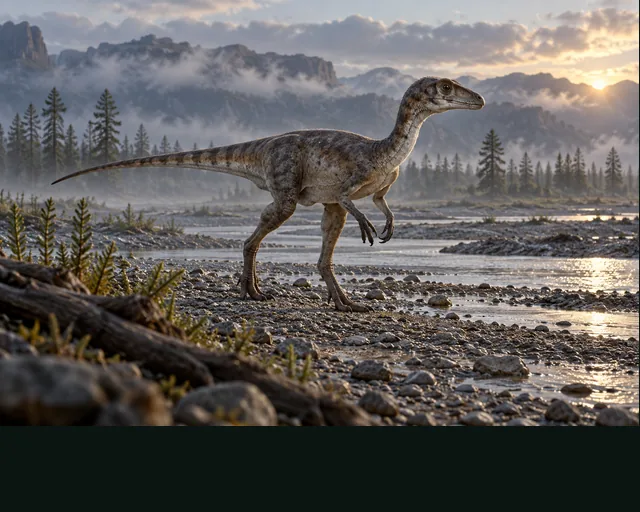
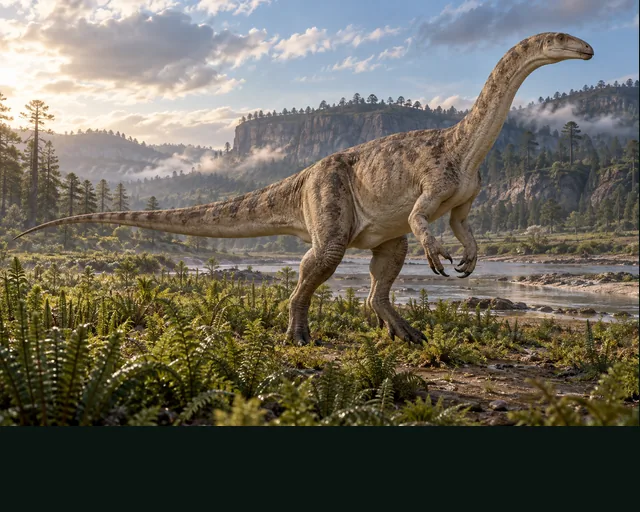
Nobu Tamura’s complete Bagualosaurus restoration supplies the visible form: a small elongated head, long low neck, grasping forelimbs, long hind limbs and a tapering tail. Its proportions, covering and colours remain interpreted. A warning about the artwork’s human scale figure means that person is omitted, and no body dimensions are read from the comparison.
Compare Eoraptor and Plateosaurus to explore varied early dinosaur body plans, then return to the A–Z directory. Evolution is easier to understand when similarities and differences are both allowed to matter.
Quick answers
- Where did Bagualosaurus live?
- In Late Triassic southern Brazil, represented by the Candelária Sequence of the Santa Maria Formation.
- Why is it important?
- The original study describes a combination of skull and body features that helps investigate changes in early sauropodomorph body plans.
- Was it already a giant four-legged sauropod?
- No. It was an early sauropodomorph, not a giant sauropod with the later columnar-limbed body plan.
- Can the reference’s human figure provide a measurement?
- No. The reference warns that its scale may be inaccurate; we omit the person and do not derive dimensions from it.
![Nobu Tamura email:[email protected] http://spinops.blogspot.com/ http://paleoexhibit.blogspot.com/](https://commons.wikimedia.org/wiki/File:Bagualosaurus_NT.jpg)