Jurassic Dinos editorial · Updated · Source-based review
Baalsaurus mansillai was a titanosaur sauropod from Late Cretaceous Patagonia, Argentina. Its named fossil is a dentary, one of the tooth-bearing bones of the lower jaw. That small portion of a giant animal can still contain a useful combination of identifying features.
Where did the jaw come from?
Calvo and Gonzalez Riga described the material from the Portezuelo Formation of the Neuquén Group. The paper appeared online in 2018 and in a 2019 journal volume, which helps explain the two dates readers may encounter.
A formation is a named body of rock, not a precise calendar year. This page keeps the broad Late Cretaceous context without adding a tightly specified age unsupported by the reviewed material. It also distinguishes the named jaw from any complete artistic body shown beside the article.
Why is the shape important?
The authors describe the dentary as L-shaped. Imagine looking down at the outline of one side of a lower jaw: the anterior and side portions form a marked bend. The paper contrasts jaw shapes descriptively, without treating an L or U outline alone as an evolutionary family tree.
Its diagnosis uses several features together, including the arrangement of tooth positions and details of the jaw’s inner surface. A diagnosis is a checked anatomical combination. It is not necessary for an animal to possess an enormous horn or unusual sail before researchers can recognize it.
What remains unknown?
A jaw can inform questions about feeding anatomy, but it cannot directly reveal the entire neck, limbs, tail or living colour. The broad plant-eating interpretation follows its titanosaur identity; a favourite food or specific feeding routine would need more evidence.
We do not borrow body dimensions from another titanosaur to make the facts panel look complete. Similar jaws in different animals are an opportunity for comparison, not a reason to combine their specimens into one imaginary complete fossil.
How our illustration is grounded
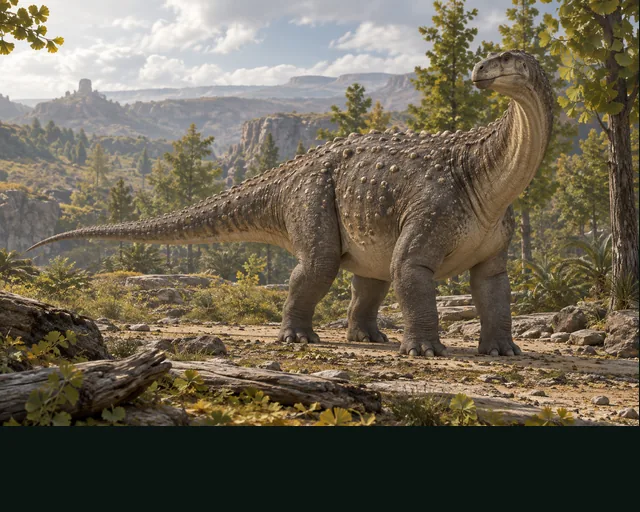
Atlantis536’s complete drawing is explicitly labelled Baalsaurus mansillai. It provides the visual reference for the small blunt head, long neck, deep trunk, four columnar legs and tapering tail. Its body proportions, soft tissues and round flank markings remain artistic interpretations. Our independent scene follows that whole restoration, not a jaw photograph or a substitute relative.
Compare Saltasaurus and Argentinosaurus, then return to the A–Z directory. Knowing which part was actually found is the first step toward asking good questions about the rest.
Quick answers
- What is Baalsaurus based on?
- A dentary, a tooth-bearing bone of the lower jaw, from the Portezuelo Formation.
- What does L-shaped mean here?
- It describes the bend in the jaw outline viewed from above, not a body posture or evolutionary rank.
- Was a whole skeleton found?
- The named type material discussed here is a jaw; a complete body is artistic restoration.
- Can another titanosaur provide its exact size?
- No. Related dinosaurs’ dimensions cannot be copied into Baalsaurus as measured facts.